



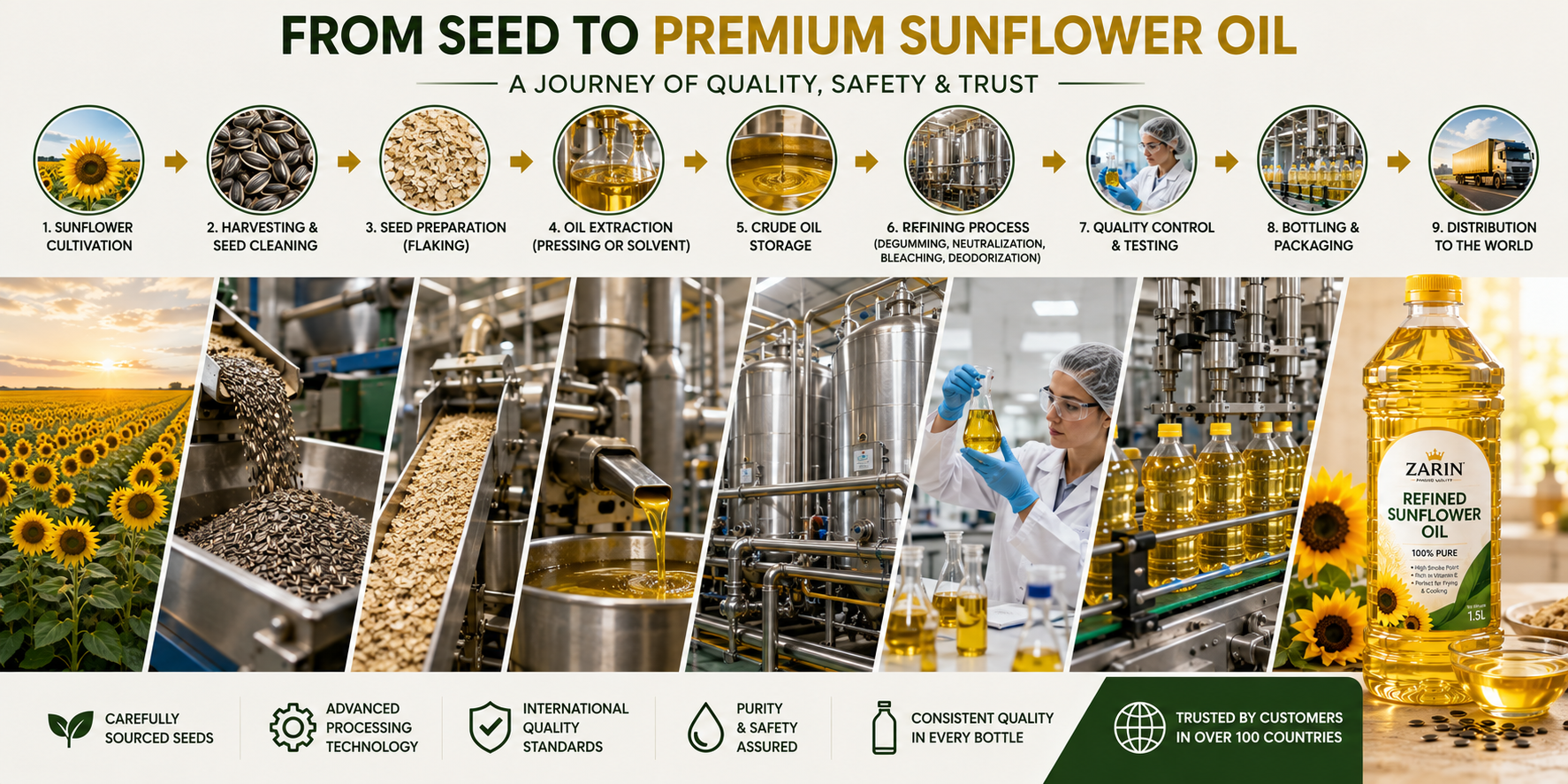
Sunflower oil is one of the world’s most widely consumed vegetable oils, valued for its light flavor, nutritional profile, and versatility in both household and industrial cooking. Behind every bottle of premium refined sunflower oil lies a carefully controlled manufacturing process designed to ensure purity, safety, consistency, and compliance with international food standards.
From cultivating sunflower crops to refining, quality testing, and packaging, every production stage contributes to the final quality of the oil.
This guide explains the complete sunflower oil production process and highlights the technologies used to produce high-quality edible oil for global markets.
Step 1: Cultivating Sunflowers
The production process begins in the field.
Sunflowers thrive in regions with:
- Long sunny days
- Moderate rainfall
- Well-drained soil
- Fertile agricultural land
Farmers carefully select high-yield sunflower varieties based on:
- Oil content
- Disease resistance
- Climate suitability
- Seed quality
Modern agricultural practices improve productivity while supporting sustainable farming.
Step 2: Harvesting Sunflower Seeds
Once the sunflower heads mature and the seeds reach the desired moisture level, harvesting begins.
Modern combines efficiently:
- Cut the flower heads
- Separate the seeds
- Remove plant material
- Collect seeds for transport
Proper harvesting minimizes seed damage and preserves oil quality.
Step 3: Cleaning the Seeds
Freshly harvested seeds contain impurities such as:
- Dust
- Stones
- Plant residue
- Metal fragments
- Broken seeds
Industrial cleaning systems use:
- Air separators
- Vibrating screens
- Magnetic separators
- Gravity tables
Only clean, high-quality seeds proceed to the next stage.
Step 4: Dehulling (Optional)
Some production facilities remove the outer hull before oil extraction.
Benefits include:
- Higher extraction efficiency
- Reduced wax content
- Improved refining performance
- Better oil quality
Depending on the intended product, some processors extract oil from whole seeds while others use dehulled kernels.
Step 5: Seed Conditioning
Before extraction, the seeds are carefully conditioned by controlling:
- Temperature
- Moisture
- Particle size
The seeds are then crushed into flakes to increase the surface area for oil extraction.
Proper conditioning significantly improves extraction efficiency.
Step 6: Oil Extraction
There are two primary methods of extracting sunflower oil.
Mechanical Pressing
Mechanical presses apply high pressure to release oil from the seeds.
Advantages include:
- Simple process
- Minimal chemical use
- Suitable for specialty oils
However, some oil remains in the seed meal.
Solvent Extraction
Large industrial facilities typically use food-grade solvent extraction to maximize oil recovery.
This process achieves:
- Higher extraction yield
- Greater production efficiency
- Better resource utilization
After extraction, the solvent is completely removed and recovered through specialized equipment.
Step 7: Crude Sunflower Oil
At this stage, the extracted oil is known as crude sunflower oil.
It still contains naturally occurring substances such as:
- Phospholipids
- Waxes
- Pigments
- Free fatty acids
- Moisture
- Trace impurities
These compounds must be removed before the oil is suitable for consumption.
Step 8: Refining Process
Refining transforms crude oil into high-quality edible sunflower oil.
The refining process generally consists of several stages.
Degumming
Phospholipids and gums are removed to improve stability.
Neutralization
Free fatty acids are reduced to improve flavor, shelf life, and product stability.
Bleaching
Natural pigments and trace contaminants are removed using specialized filtration media.
The oil becomes:
- Brighter
- Clearer
- More attractive
Winterization (When Required)
Certain waxes are removed to improve clarity, especially for oils stored in cooler environments.
Deodorization
Steam distillation under vacuum removes:
- Unwanted odors
- Volatile compounds
- Residual flavors
The result is the neutral-tasting refined sunflower oil commonly found in supermarkets.
Step 9: Quality Control
Every production batch undergoes comprehensive laboratory testing.
Typical quality parameters include:
- Free Fatty Acid (FFA)
- Peroxide Value (PV)
- Moisture
- Color
- Clarity
- Odor
- Fatty acid composition
- Oxidative stability
Manufacturers also conduct microbiological and food safety checks where applicable.
Only batches meeting established specifications proceed to packaging.
Step 10: Packaging
Refined sunflower oil is packaged in various formats depending on customer requirements.
Retail packaging includes:
- 500 ml
- 750 ml
- 1 L
- 2 L
- 3 L
- 5 L
Industrial packaging includes:
- Jerry cans
- Steel drums
- Plastic drums
- IBC containers
- Flexitanks
- Bulk tankers
Automated filling systems ensure hygiene, accuracy, and product consistency.
Food Safety Standards
Leading sunflower oil manufacturers operate under internationally recognized food safety systems such as:
- ISO 22000
- HACCP
- GMP (Good Manufacturing Practices)
- FSSC 22000 (where applicable)
These standards help ensure product quality, traceability, and consumer safety.
Sustainability in Sunflower Oil Production
Modern producers increasingly focus on:
- Responsible farming
- Water conservation
- Energy-efficient processing
- Waste reduction
- Seed meal utilization for animal feed
- Sustainable packaging
These initiatives support long-term environmental and economic sustainability.
By-Products of Sunflower Processing
Sunflower production generates valuable co-products.
Sunflower Meal
After oil extraction, the remaining meal is rich in protein and widely used in animal nutrition.
Sunflower Hulls
The hulls may be utilized for:
- Biomass fuel
- Animal bedding
- Industrial applications
Efficient use of by-products improves overall resource efficiency.
From Factory to Global Markets
Once packaged, refined sunflower oil is distributed to:
- Supermarkets
- Food manufacturers
- Restaurants
- Catering companies
- Export markets
- Private label partners
Efficient logistics and quality assurance ensure the oil reaches customers in optimal condition.
Frequently Asked Questions (FAQ)
How is sunflower oil extracted?
Sunflower oil is extracted using either mechanical pressing or solvent extraction, depending on the production scale and desired efficiency.
Why is sunflower oil refined?
Refining removes natural impurities, improves stability, enhances clarity, and creates the neutral flavor preferred by consumers.
Is refined sunflower oil safe?
Yes. When produced according to international food safety standards, refined sunflower oil is safe, stable, and suitable for everyday cooking.
What happens to the leftover sunflower meal?
The protein-rich meal is commonly used as a valuable ingredient in livestock feed.
Does refining reduce nutritional value?
Some naturally occurring compounds are reduced during refining, but the process significantly improves safety, stability, and shelf life while preserving the oil’s suitability for cooking.
Related Articles
- Everything About Sunflower Oil
- Sunflower Oil in the Food Industry
- Smoke Point of Sunflower Oil
- How to Choose Premium Sunflower Oil
- Health Benefits of Sunflower Oil
- Refined Oil vs Cold-Pressed Oil
Conclusion
The production of premium sunflower oil is a sophisticated process that combines modern agriculture, advanced extraction technologies, rigorous refining methods, and comprehensive quality control. Every stage—from seed selection and harvesting to refining and packaging—is designed to ensure that consumers receive a safe, consistent, and high-quality cooking oil.
By adhering to international food safety standards and sustainable manufacturing practices, today’s leading producers deliver sunflower oil that meets the expectations of households, food manufacturers, and global export markets alike.
Call to Action
Looking for a reliable supplier of premium refined sunflower oil?
ZAR1N delivers internationally compliant sunflower oil for retail, food service, industrial manufacturing, private label, and global export. Contact our team to learn more about our production capabilities, packaging options, and customized supply solutions for your business.
Leave a Reply