



How to Read an Edible Oil Label Correctly
Every bottle of edible oil contains valuable information that helps consumers understand what they are buying. While many shoppers focus only on the brand name or price, the product label provides important details about quality, nutritional composition, origin, storage, certifications, and safe use.
Learning how to read an edible oil label correctly enables consumers to compare products objectively, select oils suitable for their cooking needs, and avoid misleading marketing claims.
For food manufacturers, exporters, and retailers, transparent and accurate labeling is also an essential part of international food safety regulations.
Why Food Labels Matter
Food labels serve several important purposes.
They help consumers:
- Identify the product.
- Compare different oils.
- Understand nutritional value.
- Verify authenticity.
- Check freshness.
- Follow storage recommendations.
- Meet dietary preferences.
For manufacturers, labels provide traceability and regulatory compliance.
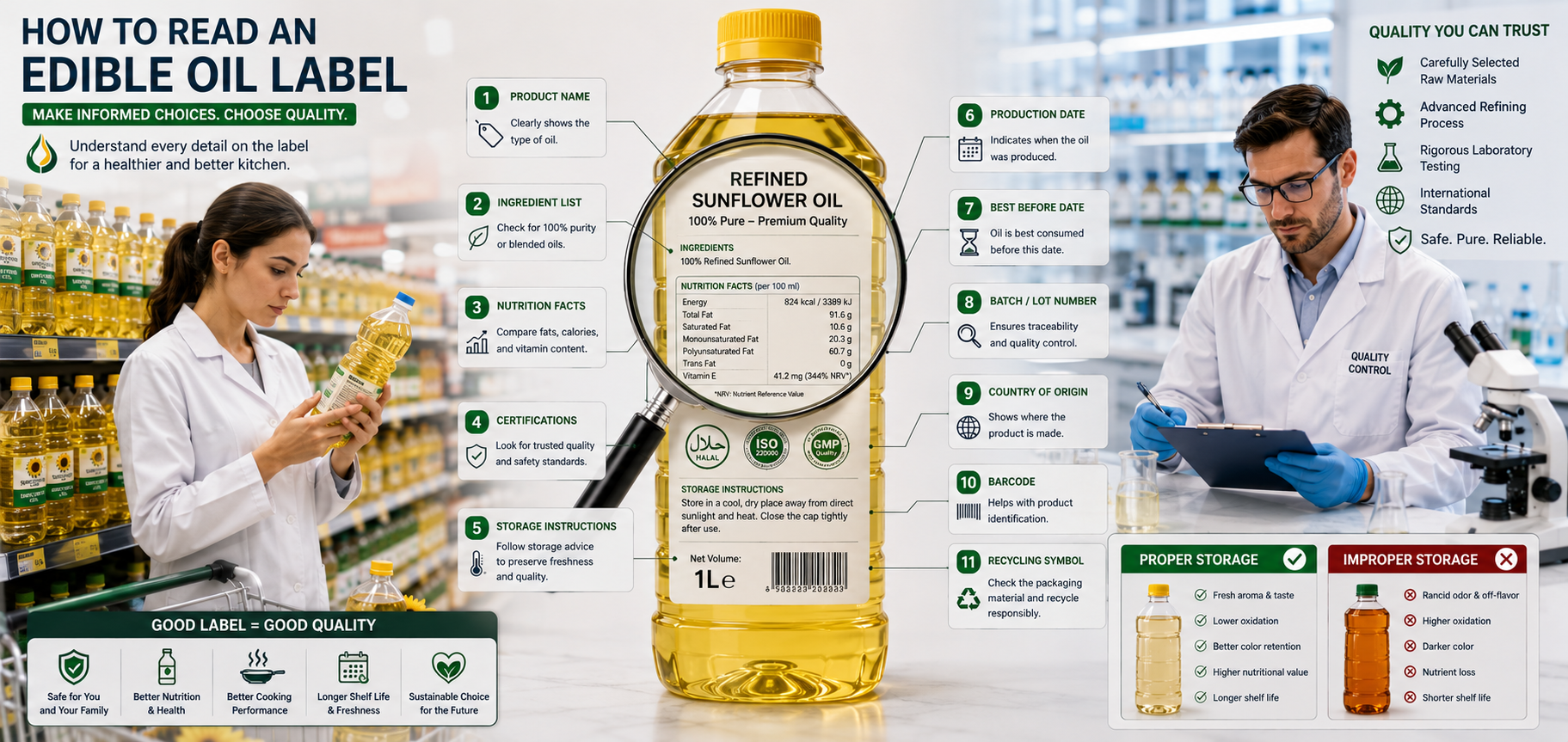
The Product Name
The product name is the first piece of information consumers should read.
Examples include:
- Refined Sunflower Oil
- High Oleic Sunflower Oil
- Extra Virgin Olive Oil
- Refined Corn Oil
- Canola Oil
The product name should clearly describe the actual contents of the bottle.
Ingredient List
Most refined edible oils contain a very simple ingredient list.
Example:
Ingredients: 100% Refined Sunflower Oil
Consumers should verify whether the product is:
- Pure oil
- Oil blend
- Flavored oil
- Fortified oil
Blended oils should clearly identify all vegetable oils included.
Nutrition Facts Panel
The nutrition panel provides standardized nutritional information.
Typical information includes:
- Energy (Calories)
- Total Fat
- Saturated Fat
- Monounsaturated Fat
- Polyunsaturated Fat
- Trans Fat
- Vitamin E (where applicable)
Values are usually presented per:
- 100 ml
- 100 g
- Serving size
This allows objective comparison between products.
Net Volume
The label specifies the quantity of oil inside the package.
Common sizes include:
- 500 ml
- 750 ml
- 1 Liter
- 2 Liters
- 5 Liters
Industrial products may also indicate larger packaging sizes.
Production Date
The manufacturing date indicates when the oil was produced.
Choosing recently produced oil generally offers:
- Better freshness
- Longer remaining shelf life
- Improved oxidation stability
Best Before or Expiration Date
Most edible oils display either:
- Best Before Date
- Expiration Date
The “Best Before” date indicates the period during which the manufacturer guarantees optimum quality under recommended storage conditions.
Batch Number (Lot Number)
Every production batch receives a unique identification code.
The batch number allows manufacturers to:
- Trace production history
- Monitor quality
- Conduct product recalls if necessary
This information is especially important for food safety systems.
Country of Origin
The label normally identifies where the product was produced.
Examples:
- Product of Türkiye
- Product of Spain
- Product of Italy
Country of origin helps consumers understand the source of raw materials and manufacturing.
Storage Instructions
Manufacturers provide recommendations such as:
- Store in a cool, dry place.
- Protect from direct sunlight.
- Keep container tightly closed.
Following these instructions helps preserve quality throughout the product’s shelf life.
Certifications
Many premium edible oils carry internationally recognized certifications.
Common examples include:
- ISO 22000
- FSSC 22000
- HACCP
- Halal Certification
- GMP
- BRCGS
These certifications indicate compliance with internationally accepted food safety and quality management systems.
Barcode
The barcode allows retailers to:
- Track inventory
- Manage sales
- Verify product identification
Although consumers rarely use it directly, it supports product traceability.
Recycling Symbols
Packaging often includes recycling information.
Common symbols indicate:
- PET plastic
- Glass
- Metal
- Recycling instructions
Proper disposal contributes to environmental sustainability.
Manufacturer Information
Every legitimate food product should identify:
- Manufacturer
- Distributor
- Importer (if applicable)
- Company address
- Customer service contact
Transparent company information builds consumer confidence.
Allergen Information
Although refined vegetable oils are generally considered safe for most consumers, labeling regulations may require declarations where relevant.
Consumers with food allergies should always review the label carefully.
Marketing Claims
Labels frequently include promotional statements such as:
- Rich in Vitamin E
- Cholesterol Free
- High Oleic
- Suitable for Frying
- Non-GMO (where applicable)
These claims should comply with applicable food regulations and should not replace objective quality evaluation.
What Consumers Should Check Before Buying
Before purchasing edible oil, verify:
- Product type
- Ingredient list
- Nutrition facts
- Production date
- Best Before date
- Packaging condition
- Certifications
- Storage instructions
- Manufacturer information
A few seconds spent reading the label can prevent poor purchasing decisions.
Common Labeling Mistakes Consumers Make
Many buyers:
- Ignore the ingredient list.
- Confuse “Best Before” with product safety.
- Assume every sunflower oil has identical properties.
- Never check production dates.
- Ignore storage recommendations.
Understanding labels helps avoid these mistakes.
Example Label Checklist
| Label Information | Why It Matters |
|---|---|
| Product Name | Identifies oil type |
| Ingredients | Confirms purity or blends |
| Nutrition Facts | Compares nutritional value |
| Net Volume | Confirms package size |
| Production Date | Indicates freshness |
| Best Before Date | Estimates quality period |
| Batch Number | Enables traceability |
| Storage Instructions | Preserves quality |
| Certifications | Demonstrates compliance |
| Country of Origin | Identifies manufacturing source |
Frequently Asked Questions (FAQ)
Why is the ingredient list important?
It confirms whether the bottle contains a single oil or a blend of multiple vegetable oils.
Is the “Best Before” date the same as an expiration date?
Not exactly. “Best Before” indicates optimal quality rather than immediate safety.
Why should I check the production date?
Newer production dates usually provide longer remaining shelf life and better freshness.
What does the batch number do?
It enables manufacturers to trace every production lot for quality control and food safety.
Do certifications guarantee quality?
Certifications demonstrate compliance with recognized quality and food safety systems, but consumers should still evaluate other label information.
Related Articles
- How to Identify High-Quality Cooking Oil
- Shelf Life of Edible Oils
- Storage Conditions for Cooking Oils
- Color, Aroma and Clarity of Edible Oils
- Peroxide Value Explained
- Free Fatty Acids Explained
Conclusion
An edible oil label provides far more than branding and marketing. It contains essential information about ingredients, nutritional composition, freshness, storage, certifications, and traceability. Understanding how to read these details enables consumers to make informed purchasing decisions and select products that meet both quality expectations and cooking requirements. Transparent labeling also reflects a manufacturer’s commitment to food safety, regulatory compliance, and consumer trust.
Call to Action
Choose edible oils with clear, transparent labeling, internationally recognized certifications, and complete product information. A well-labeled product reflects professional manufacturing standards and helps ensure every bottle delivers the quality, freshness, and confidence you expect.
Leave a Reply