



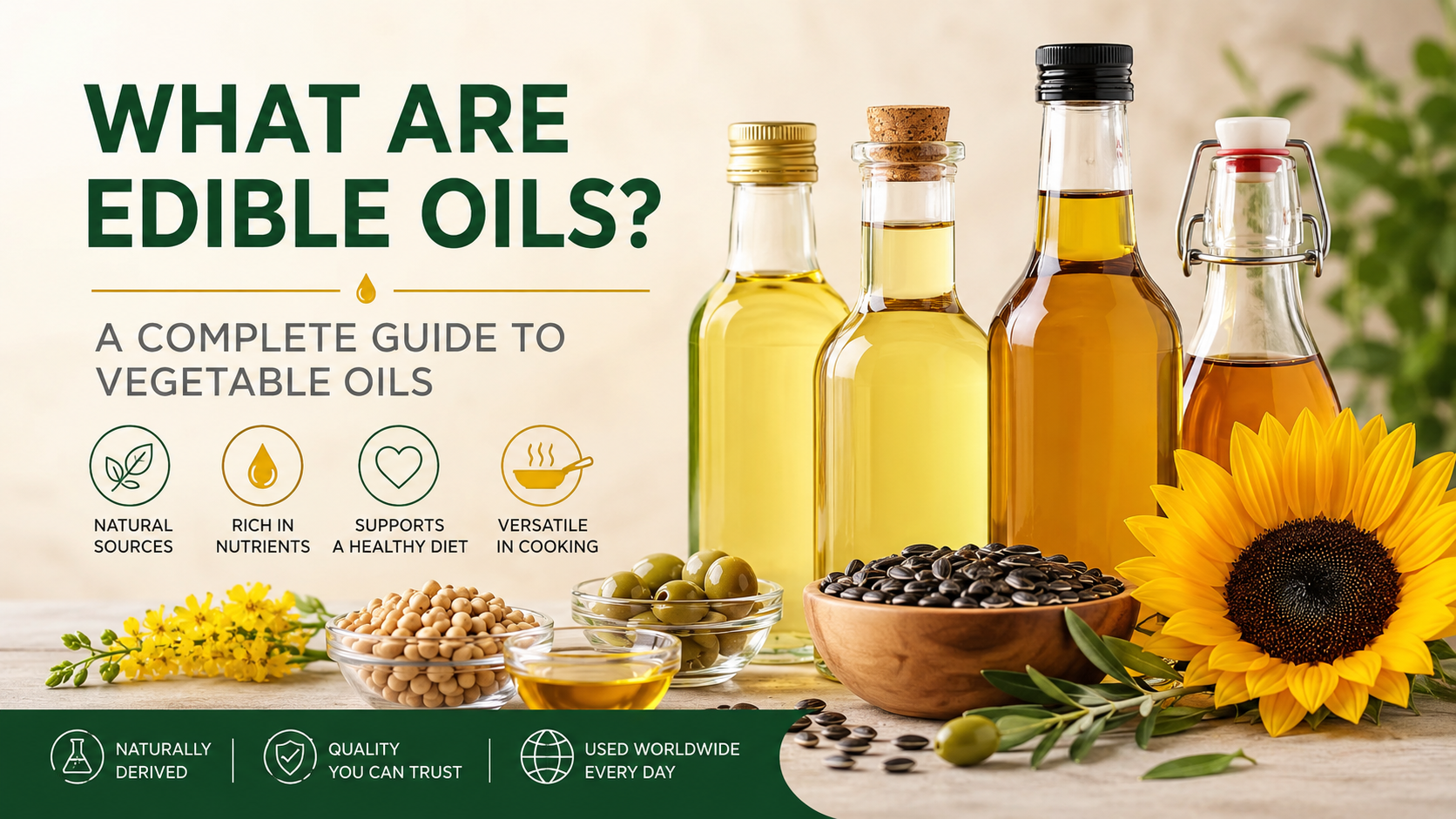
Edible oils are an essential part of food preparation, nutrition and industrial food production. They are used for frying, baking, salad dressings, sauces, margarine, confectionery products and many other food applications.
However, not all edible oils are the same. Their source, fatty-acid composition, production method, flavour, heat resistance and storage stability can differ significantly.
Understanding these differences helps consumers, food manufacturers and professional buyers select the right oil for each application.
What Is an Edible Oil?
Edible fats and oils are primarily composed of glycerides of fatty acids and may originate from vegetable, animal or marine sources. Edible vegetable oils are obtained exclusively from plant sources and may naturally contain small amounts of other lipid compounds and free fatty acids.
In simple terms, an edible oil is a fat that is suitable for human consumption and has been produced, processed and stored under appropriate food-safety conditions.
Although the words “fat” and “oil” are often used differently, they describe closely related substances. Products that remain liquid at room temperature are generally called oils, while those that remain solid or semi-solid are usually called fats.
Where Do Edible Oils Come From?
Edible oils can be divided into several main groups according to their source.
Vegetable oils
Vegetable oils are obtained from seeds, fruits, nuts or grains. Common examples include:
- Sunflower oil
- Olive oil
- Canola or rapeseed oil
- Soybean oil
- Corn oil
- Sesame oil
- Peanut oil
- Cottonseed oil
- Palm oil
- Coconut oil
- Avocado oil
Sunflower, soybean, canola, flaxseed, peanut and cottonseed are examples of important oilseed crops. Olive, coconut and palm oils, however, are obtained from fruit or fruit kernels rather than conventional oilseeds.
Animal fats
Animal fats are obtained from animal tissues or dairy products. Common examples include:
- Butter
- Ghee
- Lard
- Tallow
- Poultry fat
Animal fats generally have different flavour, texture and fatty-acid characteristics compared with most liquid vegetable oils.
Marine oils
Marine oils are obtained from fish and other marine sources. They are primarily used in specialised food, nutrition and supplement applications rather than everyday frying.
How Are Vegetable Oils Produced?
The production method depends on the raw material and the desired final product. In general, vegetable-oil production may include the following stages:
- Cleaning and preparation of seeds or fruits
- Crushing, pressing or extraction
- Separation of the oil from the remaining solid material
- Filtration
- Refining, when required
- Quality testing
- Packaging and storage
Some oils are obtained mainly through mechanical pressing. Others may be extracted and then refined to improve their appearance, flavour, stability and suitability for cooking.
Refining commonly removes unwanted substances, odours, pigments, free fatty acids and other impurities. It can produce an oil with a lighter colour, neutral flavour, improved oxidative stability and better suitability for frying.
Refined Oils and Unrefined Oils
One of the most important distinctions between edible oils is whether the oil has been refined.
Refined oils
Refined oils are processed to create a more neutral, stable and consistent product. They are widely used for:
- Frying
- General cooking
- Industrial food production
- Baking
- Sauces and mayonnaise
- Packaged foods
Refined sunflower oil is a common example. Its mild flavour and broad range of applications make it suitable for household and professional food use.
Unrefined or virgin oils
Unrefined oils undergo less processing and may retain more of their natural colour, aroma and flavour.
Examples include:
- Extra virgin olive oil
- Cold-pressed sunflower oil
- Cold-pressed sesame oil
- Virgin coconut oil
These oils may be preferred for salads, dressings and recipes where their characteristic flavour is desirable. They are not automatically better for every purpose; suitability depends on the type of oil, production quality and intended cooking method.
Saturated and Unsaturated Fats
The behaviour and nutritional properties of an oil are influenced by its fatty-acid composition.
Unsaturated fats
Unsaturated fats include monounsaturated and polyunsaturated fatty acids. They are commonly present in higher proportions in plant oils and are generally liquid at room temperature. Sunflower, olive, soybean and canola oils are recognised sources of unsaturated fats.
Saturated fats
Saturated fats occur in higher proportions in products such as butter, ghee, lard, coconut oil and palm oil. The proportions vary considerably from one product to another.
The World Health Organization advises that dietary fat should come primarily from unsaturated fatty acids, while saturated and trans-fat intake should be limited.
This does not mean that every vegetable oil has the same composition. Coconut and palm oils, for example, contain higher proportions of saturated fatty acids than sunflower, olive or canola oils.
What Are Edible Oils Used For?
Different oils perform differently during cooking and food manufacturing.
Frying
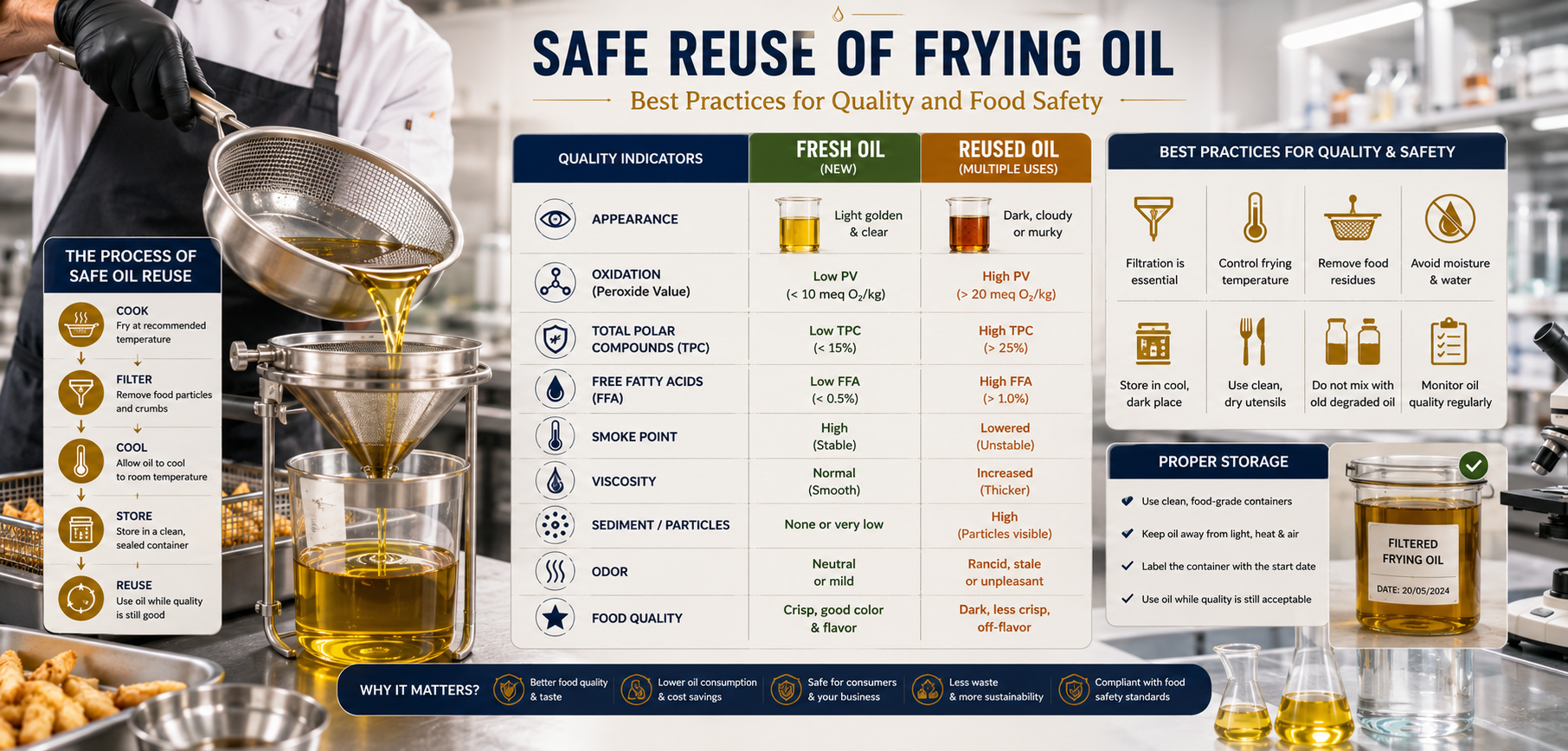
Oils selected for frying should have suitable heat performance, flavour neutrality and oxidative stability. Refined oils are generally preferred for this purpose.
Salad dressings
Olive oil, cold-pressed oils and mild refined oils can be used in salad dressings, depending on the desired flavour.
Baking
Sunflower, canola, corn and other neutral-tasting oils can provide moisture and texture without introducing a strong flavour.
Food manufacturing
Edible oils are used in:
- Mayonnaise
- Sauces
- Snacks
- Biscuits
- Cakes
- Margarine
- Confectionery
- Ready-made meals
- Canned foods
The correct oil must be selected according to flavour, texture, shelf-life, processing temperature and product specifications.
How Is the Quality of Edible Oil Evaluated?
Oil quality cannot be judged by colour alone. Professional evaluation may include:
- Raw-material quality
- Fatty-acid composition
- Free fatty-acid level
- Peroxide value
- Moisture and impurities
- Oxidation stability
- Taste and odour
- Colour and clarity
- Production date
- Packaging integrity
- Storage conditions
- Compliance with applicable standards
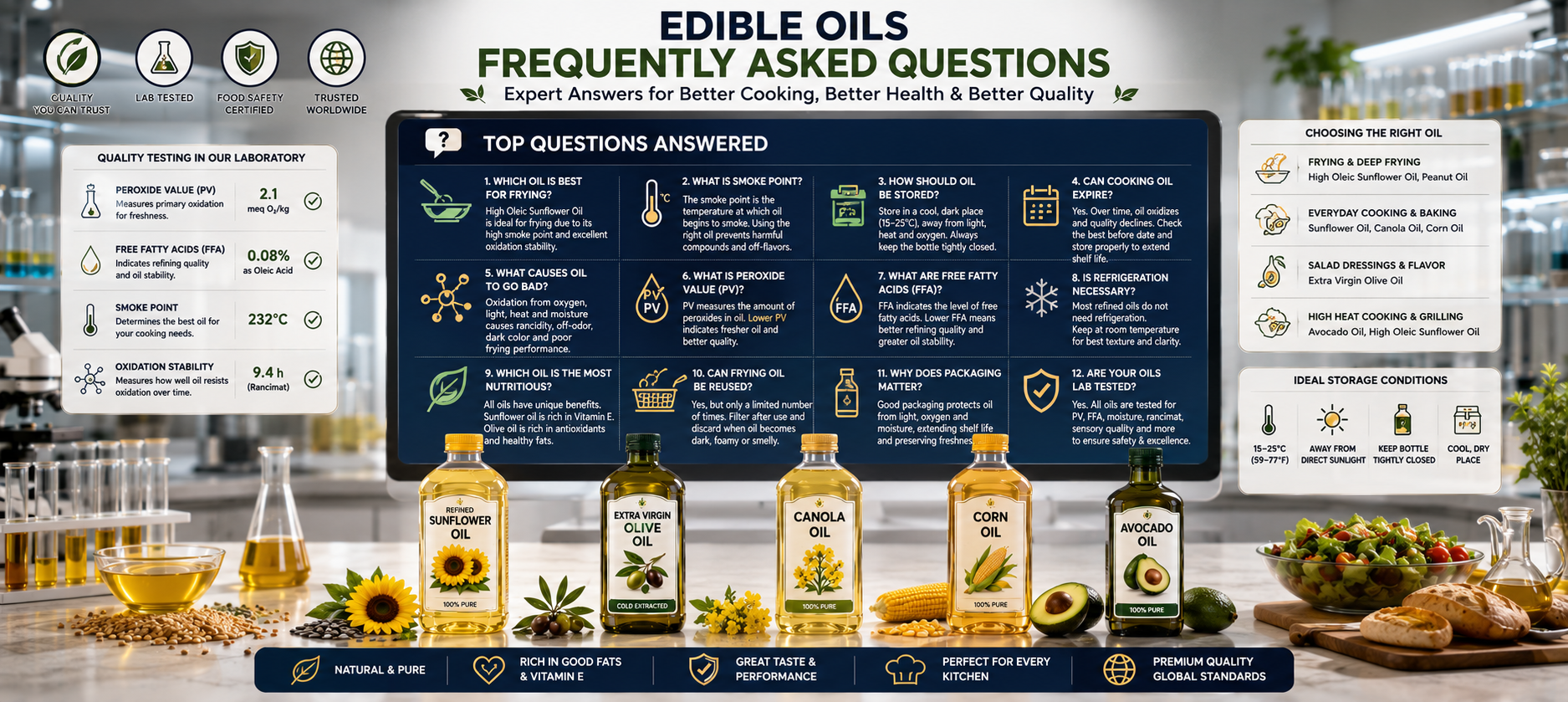
Free fatty acids and peroxide values are particularly important laboratory indicators. Free fatty acids can increase because of poor raw-material handling or degradation, while peroxide value is used as an indicator of primary oxidation.
These technical values will be explained individually in later articles in the ZAR1N Knowledge Center.
How Should Edible Oils Be Stored?
Edible oils should generally be protected from:
- Direct sunlight
- Excessive heat
- Air and oxygen
- Moisture
- Strong odours
- Contaminated containers
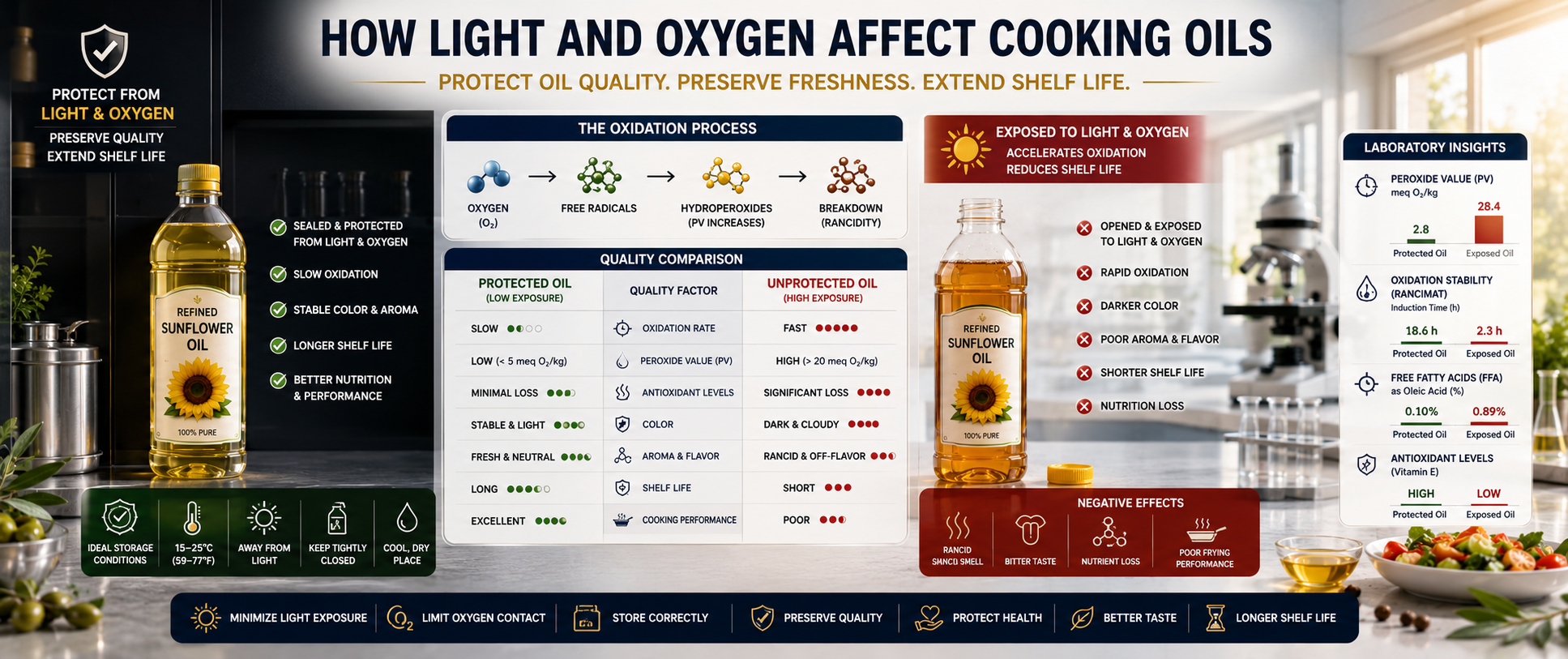
The bottle or container should remain tightly closed. Oil should be kept in a cool, dry and clean location, away from ovens, windows and other heat sources.
Light, heat and oxygen can accelerate oxidation and gradually affect flavour, aroma and overall quality.
Is One Oil Suitable for Every Purpose?
There is no single oil that is ideal for every application.
A suitable choice depends on:
- Cooking temperature
- Desired flavour
- Fatty-acid profile
- Processing method
- Required shelf-life
- Household or industrial application
- Quality specifications
- Packaging and storage conditions
For example, an extra virgin olive oil may be selected for flavour in a salad, while a refined sunflower oil may be more suitable when a neutral taste is needed for cooking or food manufacturing.
Conclusion
Edible oils are a diverse group of food ingredients obtained from vegetable, animal and marine sources. Their quality and suitability depend on much more than their appearance.
Source, fatty-acid composition, refining method, heat stability, freshness, packaging and storage must all be considered when selecting an oil.
By understanding these fundamentals, consumers and businesses can make more informed choices and select the most appropriate oil for each application.
Frequently Asked Questions
Are all vegetable oils edible?
No. Only oils produced from suitable raw materials and processed according to food-safety requirements are intended for human consumption.
Is refined oil lower quality than cold-pressed oil?
Not necessarily. They are produced for different purposes. Refined oils generally offer neutral flavour and improved consistency, while cold-pressed oils may retain more natural aroma and flavour.
Why are some oils solid at room temperature?
The physical state of an oil or fat depends largely on its fatty-acid composition and the surrounding temperature.
Can colour show whether an oil is high quality?
Colour alone is not a reliable quality test. Laboratory values, freshness, aroma, flavour, packaging and storage history are also important.
Which edible oil is best?
The best choice depends on the intended use. Oils suitable for salad dressing may not offer the same properties required for repeated high-temperature food processing.
Leave a Reply