



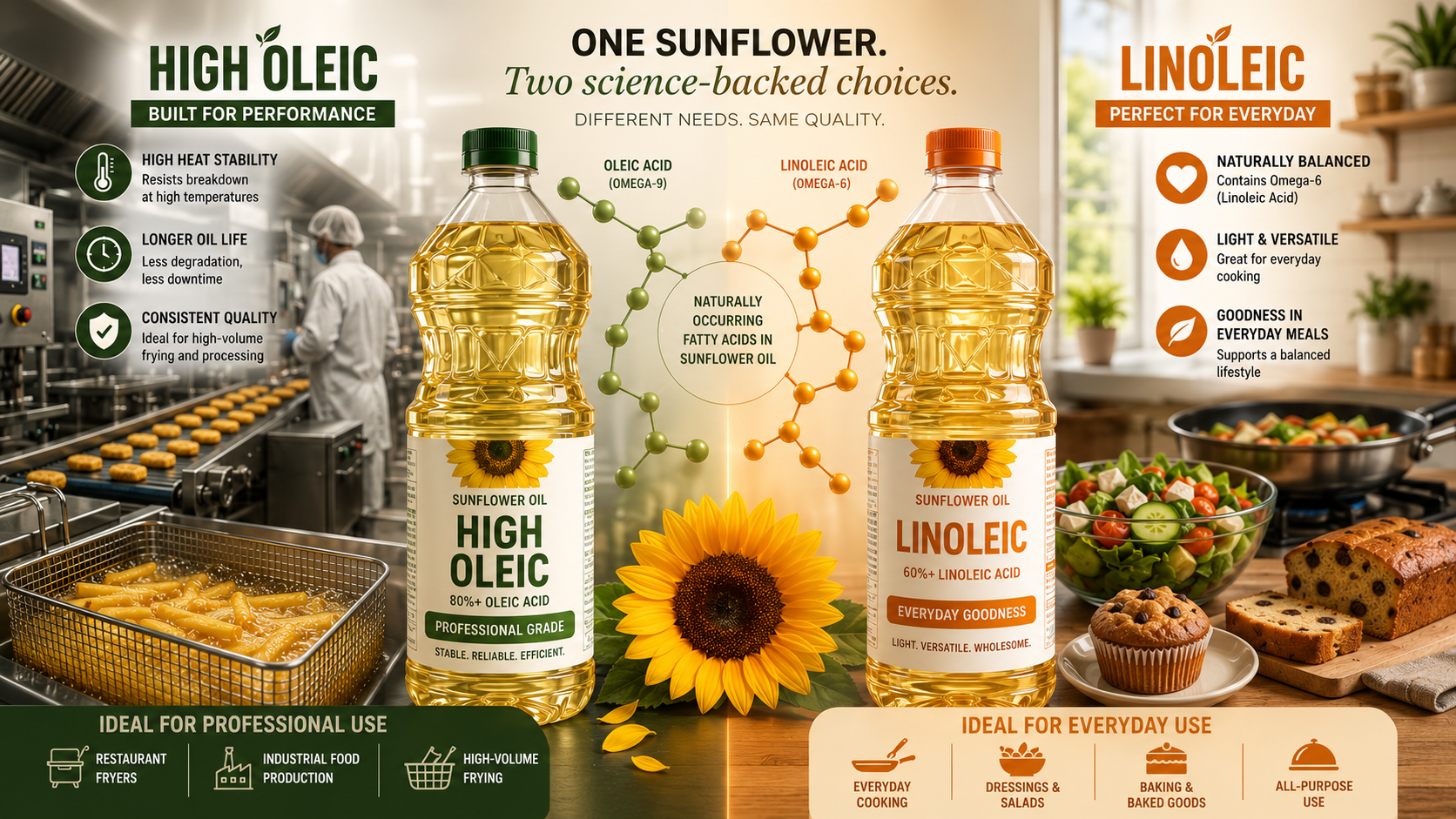
Many consumers are surprised to learn that not all sunflower oil is the same. While all sunflower oils come from the seeds of the sunflower plant (Helianthus annuus), different sunflower varieties produce oils with distinct fatty acid compositions and functional properties.
The two most common types are:
- Linoleic Sunflower Oil
- High Oleic Sunflower Oil
Although they look very similar, these oils differ in stability, cooking performance, and preferred applications.
Understanding these differences can help consumers, chefs, food manufacturers, and importers choose the right product for their needs.
What Determines the Difference?
The primary difference lies in the fatty acid profile of the sunflower seed—not in the refining process.
Plant breeders have developed different sunflower varieties that naturally produce oils with varying proportions of:
- Oleic acid (a monounsaturated fatty acid)
- Linoleic acid (a polyunsaturated fatty acid)
This natural variation gives each oil its unique characteristics.
What Is Linoleic Sunflower Oil?
Linoleic sunflower oil is the traditional and most widely available type of sunflower oil.
It has been produced commercially for decades and is commonly found in supermarkets around the world.
Main Characteristics
- Mild flavor
- Light color
- Neutral aroma
- Rich in polyunsaturated fatty acids
- Suitable for a wide range of cooking applications
Because of its versatility and affordability, it remains one of the most popular edible oils for household use.
What Is High Oleic Sunflower Oil?
High Oleic sunflower oil is produced from specially cultivated sunflower varieties that naturally contain a much higher percentage of oleic acid.
Unlike traditional sunflower oil, High Oleic oil offers enhanced oxidative stability and performs exceptionally well during prolonged heating.
Main Characteristics
- Mild flavor
- High heat stability
- Excellent frying performance
- Longer usable life during continuous frying
- Greater resistance to oxidation
These properties make it a preferred choice for commercial kitchens and food manufacturers.
Fatty Acid Comparison
Although exact values vary by variety and manufacturer, the typical composition is:
| Fatty Acid | Linoleic Sunflower Oil | High Oleic Sunflower Oil |
|---|---|---|
| Oleic Acid | 20–35% | 75–90% |
| Linoleic Acid | 55–70% | 5–15% |
| Saturated Fat | 8–12% | 6–10% |
The defining feature of High Oleic sunflower oil is its significantly higher concentration of monounsaturated fats.
Heat Stability
One of the biggest practical differences is how the oils perform during cooking.
Linoleic Sunflower Oil
Suitable for:
- Everyday cooking
- Baking
- Sautéing
- Light frying
High Oleic Sunflower Oil
Recommended for:
- Deep frying
- Commercial kitchens
- Continuous frying
- Industrial food production
Its greater resistance to oxidation allows it to maintain quality for longer periods under repeated heating.
Oxidative Stability
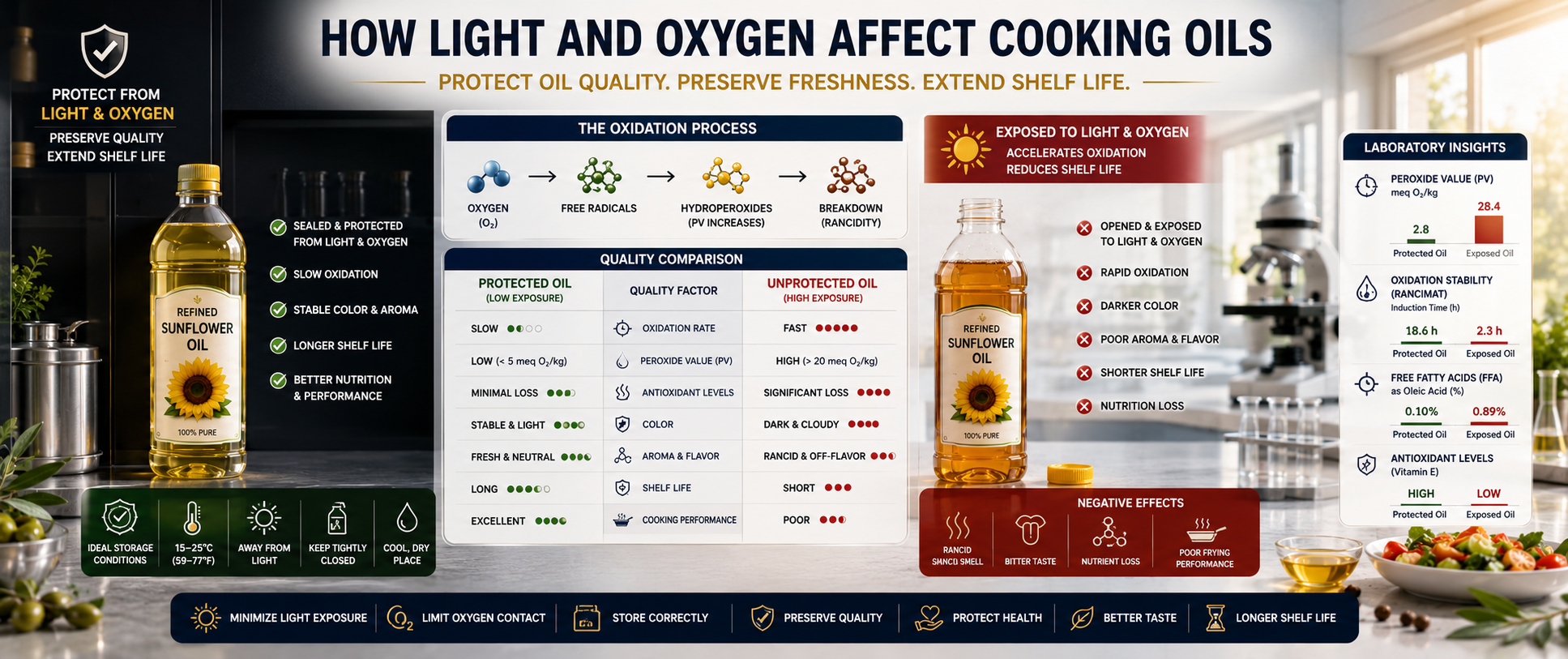
Oxidation is a natural process that occurs when oils are exposed to heat, oxygen, and light.
High Oleic sunflower oil is naturally more resistant to oxidation than traditional Linoleic sunflower oil because of its fatty acid composition.
This contributes to:
- Longer frying life
- Improved flavor stability
- Better product consistency
- Reduced frequency of oil replacement in commercial settings
Smoke Point
Both refined Linoleic and High Oleic sunflower oils have relatively high smoke points.
Approximate values are:
| Oil | Smoke Point |
|---|---|
| Refined Linoleic Sunflower Oil | ~230°C |
| Refined High Oleic Sunflower Oil | ~230–240°C |
While their smoke points are similar, High Oleic oil generally performs better during extended or repeated frying due to its greater oxidative stability.
Flavor Comparison
Both oils are appreciated for their neutral taste.
| Feature | Linoleic | High Oleic |
|---|---|---|
| Flavor | Mild | Mild |
| Aroma | Neutral | Neutral |
| Color | Light Golden | Light Golden |
This neutrality makes them suitable for recipes where the oil should not dominate the flavor.
Household Applications
Linoleic Sunflower Oil
Commonly used for:
- Daily meals
- Baking
- Light frying
- Roasting
- Homemade sauces
High Oleic Sunflower Oil
Suitable for:
- High-temperature frying
- Gourmet cooking
- Large family meals
- Recipes requiring prolonged heating
Both oils can be used in home kitchens, depending on cooking habits.
Industrial Applications
High Oleic sunflower oil has become increasingly important in food manufacturing.
It is commonly used in:
- Potato chips
- French fries
- Frozen foods
- Snack foods
- Bakery products
- Quick-service restaurants
- Commercial frying operations
Its stability helps manufacturers maintain consistent product quality.
Shelf Life
Under proper storage conditions:
Linoleic Sunflower Oil
- Good shelf life
- Best stored away from heat and light
High Oleic Sunflower Oil
- Excellent shelf life
- Improved stability during storage
- Better resistance to oxidation
Regardless of type, all oils should be stored in tightly sealed containers in cool, dry conditions.
Which One Is Better?
There is no universal answer.
The right choice depends on how the oil will be used.
Choose Linoleic Sunflower Oil if you:
- Cook mainly at home
- Bake frequently
- Want an economical everyday cooking oil
- Prefer a versatile all-purpose oil
Choose High Oleic Sunflower Oil if you:
- Deep fry regularly
- Operate a restaurant
- Manufacture food products
- Need greater frying stability
- Want longer performance during continuous cooking
Each oil is designed to excel in different applications.
Comparison Table
| Feature | Linoleic | High Oleic |
|---|---|---|
| Main Fat Type | Polyunsaturated | Monounsaturated |
| Everyday Cooking | Excellent | Excellent |
| Deep Frying | Good | Excellent |
| Continuous Frying | Moderate | Excellent |
| Oxidative Stability | Good | Excellent |
| Commercial Food Industry | Good | Outstanding |
| Neutral Flavor | ✔ | ✔ |
Frequently Asked Questions (FAQ)
What does “High Oleic” mean?
It refers to sunflower oil produced from sunflower varieties that naturally contain a much higher proportion of oleic acid compared to traditional sunflower oil.
Is High Oleic sunflower oil genetically modified?
Not necessarily. High Oleic sunflower varieties are typically developed through conventional plant breeding rather than genetic modification, although practices may vary by region and producer.
Which oil is better for restaurants?
High Oleic sunflower oil is often preferred because of its excellent stability during repeated high-temperature frying.
Can I use High Oleic sunflower oil at home?
Yes. It performs very well in household cooking, especially if you frequently fry foods.
Do both oils contain vitamin E?
Yes. Both types naturally contain vitamin E, although the exact amount depends on the sunflower variety and processing method.
Related Articles
- Everything About Sunflower Oil
- Nutritional Value of Sunflower Oil
- Health Benefits of Sunflower Oil
- Is Sunflower Oil Good for Frying?
- Smoke Point of Sunflower Oil
- Sunflower Oil in the Food Industry
Conclusion
High Oleic and Linoleic sunflower oils share the same origin but are designed for different purposes. Linoleic sunflower oil is an excellent all-purpose choice for everyday cooking, while High Oleic sunflower oil offers superior stability for commercial frying and industrial food production.
By understanding the strengths of each type, consumers and businesses can select the oil that best matches their cooking methods, operational needs, and quality expectations.
Call to Action
At ZAR1N, we provide both conventional and High Oleic sunflower oil solutions tailored to the needs of households, restaurants, food manufacturers, and international distributors. Whether you require premium refined sunflower oil for everyday use or High Oleic sunflower oil for demanding commercial applications, our products are manufactured to international quality standards and supported by reliable global supply chains. Partner with ZAR1N for consistent performance, food safety, and customized private label solutions.
Leave a Reply