



Sunflower Oil vs Canola Oil
Sunflower oil and canola oil are two of the most widely used vegetable oils in households and commercial food production. Both are valued for their versatility, mild flavor, and excellent cooking performance, yet they differ in fatty acid composition, nutritional profile, oxidation stability, and ideal culinary uses.
Consumers often ask:
Which oil is healthier for everyday cooking?
The answer depends on how the oil will be used, the cooking temperature, and whether nutritional composition or frying performance is the primary consideration.
Rather than identifying a single “best” oil, understanding the characteristics of each allows consumers to select the most appropriate oil for specific applications.
What Is Sunflower Oil?
Sunflower oil is extracted from the seeds of the sunflower plant (Helianthus annuus).
Commercial varieties include:
- Refined Sunflower Oil
- High Oleic Sunflower Oil
- Cold-Pressed Sunflower Oil
Refined sunflower oil is especially popular because of its:
- Neutral flavor
- Light color
- High smoke point
- Excellent frying characteristics
High Oleic sunflower oil contains significantly higher levels of monounsaturated fat, resulting in improved oxidative stability.
What Is Canola Oil?
Canola oil is produced from specially cultivated varieties of rapeseed (Brassica napus) developed to contain very low levels of erucic acid.
Modern canola oil is characterized by:
- Mild flavor
- Low saturated fat
- Good oxidative stability
- Balanced fatty acid composition
It is widely used for cooking, baking, salad dressings, and commercial food manufacturing.
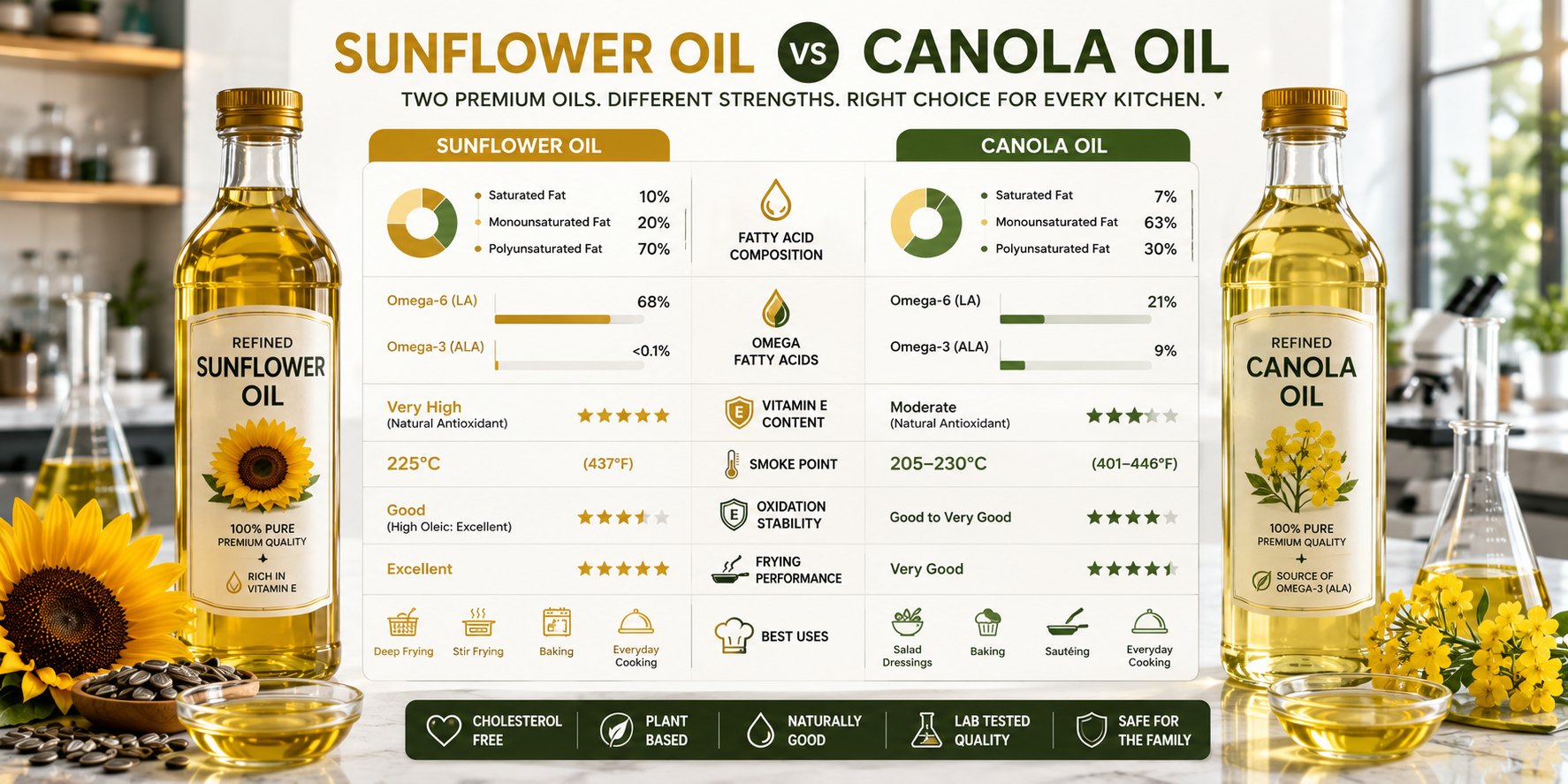
Nutritional Comparison
Both oils provide approximately the same caloric value.
| Nutrient (Approximate) | Sunflower Oil | Canola Oil |
|---|---|---|
| Calories | 884 kcal | 884 kcal |
| Total Fat | 100 g | 100 g |
| Saturated Fat | Low | Very Low |
| Monounsaturated Fat | Moderate (High Oleic: High) | High |
| Polyunsaturated Fat | High | Moderate |
| Vitamin E | Very High | Moderate |
| Cholesterol | 0 mg | 0 mg |
Both oils are naturally cholesterol-free.
Fatty Acid Profile
One of the major differences lies in fatty acid composition.
Conventional Sunflower Oil
Rich in:
- Linoleic Acid (Omega-6)
Contains moderate amounts of Oleic Acid.
High Oleic Sunflower Oil
Contains significantly more:
- Oleic Acid (Omega-9)
This improves oxidation stability and frying performance.
Canola Oil
Contains:
- Oleic Acid (Omega-9)
- Linoleic Acid (Omega-6)
- Alpha-Linolenic Acid (Omega-3)
Canola oil is one of the few commonly used cooking oils that naturally contains a measurable amount of plant-based Omega-3 fatty acids.
Vitamin E
Sunflower oil is one of the richest natural dietary sources of Vitamin E.
Vitamin E functions as:
- A powerful antioxidant
- Protection against oxidative damage
- Support for cell membranes
Canola oil also contains Vitamin E, although generally in lower concentrations.
Smoke Point
Smoke point influences cooking performance.
Approximate values:
| Oil | Smoke Point |
|---|---|
| Refined Sunflower Oil | ~225°C |
| High Oleic Sunflower Oil | ~230°C |
| Refined Canola Oil | ~205–230°C |
Both oils are suitable for high-temperature cooking when properly refined.
Frying Performance
Sunflower oil performs exceptionally well for:
- Deep frying
- Commercial food production
- Fast-food operations
- Snack manufacturing
High Oleic sunflower oil provides even greater frying stability.
Canola oil is also widely used for frying because of its:
- Mild flavor
- Balanced fatty acid profile
- Good heat tolerance
Baking
Both oils are excellent choices for baking.
They provide:
- Moist texture
- Neutral taste
- Consistent performance
The selection often depends on regional preference and recipe requirements.
Flavor
Both refined oils possess mild flavors.
Refined Sunflower Oil
- Neutral
- Light
- Clean
Refined Canola Oil
- Mild
- Slightly buttery (very subtle)
- Neutral in most recipes
Both allow the natural flavors of foods to dominate.
Oxidation Stability
Oxidative stability depends largely on fatty acid composition.
General comparison:
- High Oleic Sunflower Oil → Excellent
- Canola Oil → Good to Very Good
- Conventional Sunflower Oil → Moderate
Proper refining and storage strongly influence actual stability.
Health Considerations
Both oils contain predominantly unsaturated fats and can be included in a balanced diet.
Sunflower oil offers:
- Very high Vitamin E
- Unsaturated fatty acids
Canola oil provides:
- Low saturated fat
- Monounsaturated fats
- Plant-based Omega-3 fatty acids
Overall dietary quality remains more important than any individual cooking oil.
Industrial Applications
Sunflower oil is commonly used in:
- Snack production
- Frozen foods
- Restaurant frying
- Food service
Canola oil is frequently used for:
- Salad dressings
- Mayonnaise
- Margarine
- Baking
- Everyday cooking
Both oils are widely used in the food industry.
Price Comparison
Prices vary by region, harvest conditions, and market demand.
Generally:
- Refined sunflower oil and refined canola oil are similarly priced in many international markets.
- High Oleic sunflower oil may command a premium because of its specialized production.
Which Oil Should You Choose?
Choose Sunflower Oil if you prefer:
- High Vitamin E
- Excellent frying performance
- Neutral flavor
- High smoke point
Choose High Oleic Sunflower Oil if you require:
- Superior frying stability
- Longer frying life
- Commercial food production
Choose Canola Oil if you prefer:
- A balanced fatty acid profile
- Naturally occurring Omega-3 fatty acids
- Mild everyday cooking oil
- Versatile home cooking
Many households benefit from using both oils for different culinary purposes.
Comparison Table
| Feature | Sunflower Oil | Canola Oil |
|---|---|---|
| Flavor | Neutral | Neutral |
| Vitamin E | Excellent | Good |
| Omega-3 | Very Low | Present |
| Omega-6 | High | Moderate |
| Smoke Point | High | High |
| Frying | Excellent | Very Good |
| Baking | Excellent | Excellent |
| Oxidation Stability | Moderate–Excellent | Good–Very Good |
| Commercial Use | Extensive | Extensive |
Frequently Asked Questions (FAQ)
Which oil contains more Vitamin E?
Sunflower oil generally contains significantly more Vitamin E than canola oil.
Does canola oil contain Omega-3?
Yes. Canola oil naturally contains alpha-linolenic acid (ALA), a plant-based Omega-3 fatty acid.
Which oil is better for deep frying?
Refined sunflower oil, particularly High Oleic sunflower oil, is widely recognized for its excellent frying performance and oxidation resistance.
Can both oils be used every day?
Yes. Both oils can be part of a balanced diet when used appropriately and in moderation.
Which oil has a more neutral taste?
Both refined sunflower oil and refined canola oil have very mild, neutral flavors suitable for a wide variety of recipes.
Related Articles
- Sunflower Oil vs Olive Oil
- Sunflower Oil vs Corn Oil
- Sunflower Oil vs Soybean Oil
- High Oleic vs Linoleic Sunflower Oil
- Which Oil Is Best for Frying?
- Smoke Point of Sunflower Oil
Conclusion
Sunflower oil and canola oil are both versatile, high-quality cooking oils with distinct advantages. Sunflower oil stands out for its exceptionally high Vitamin E content, neutral flavor, and excellent frying performance, while canola oil is valued for its balanced fatty acid profile and naturally occurring Omega-3 content. Selecting the most suitable oil depends on cooking method, nutritional priorities, and personal preference. Many professional kitchens and households successfully incorporate both oils into their daily cooking routines.
Call to Action
Explore our premium selection of refined sunflower oils and High Oleic sunflower oils, produced under internationally recognized food safety standards. Designed for home kitchens, food manufacturers, and international markets, our oils deliver exceptional quality, stability, and reliable performance in every application.
Leave a Reply