



The quality of edible oils is not determined only by their appearance, aroma, or nutritional composition. One of the most important characteristics of premium cooking oils is their ability to resist oxidation over time.
This characteristic is known as Oxidation Stability.
Oxidation stability determines how long an oil can remain fresh during storage, transportation, industrial processing, and cooking. Oils with higher oxidative stability maintain their quality for longer periods, while unstable oils deteriorate more rapidly when exposed to oxygen, light, or heat.
For manufacturers, food processors, and exporters, oxidation stability is among the most important laboratory indicators used to predict shelf life and product performance.
What Is Oxidation Stability?
Oxidation stability refers to an edible oil’s resistance to oxidative deterioration.
Simply put, it measures how long an oil can withstand exposure to oxygen before significant chemical degradation begins.
The higher the oxidation stability:
- The slower the oil deteriorates.
- The longer it remains fresh.
- The better its cooking performance.
- The greater its shelf life.
Why Oxidation Matters
Oxidation is a natural chemical reaction between oxygen and the unsaturated fatty acids found in edible oils.
Although unavoidable over time, oxidation can be significantly slowed through:
- Proper refining
- Appropriate packaging
- Controlled storage
- High-quality raw materials
- Natural antioxidants
Without these protections, oxidation gradually damages oil quality.
What Happens During Oxidation?
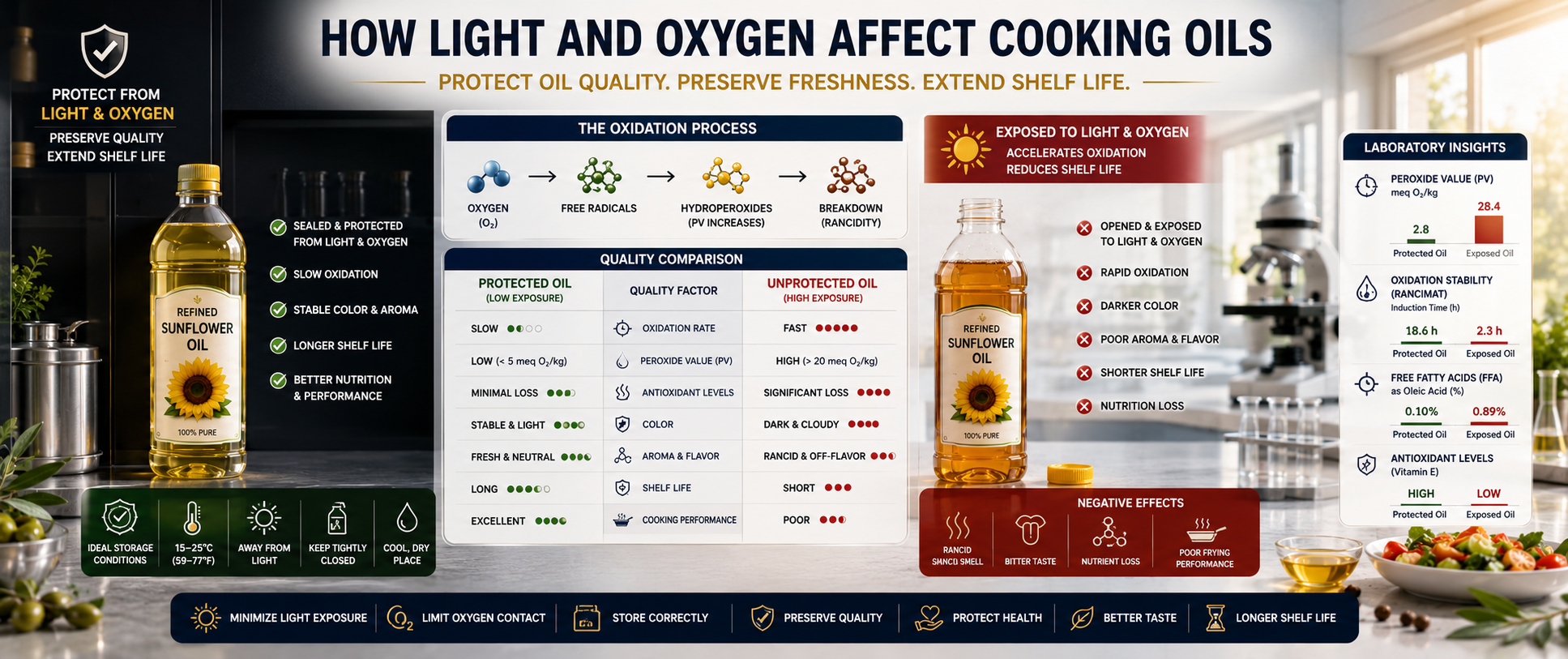
Oxidation progresses through several stages.
Stage 1 – Initiation
Oxygen molecules react with unsaturated fatty acids.
Stage 2 – Propagation
Hydroperoxides begin to form.
These are measured by the Peroxide Value (PV).
Stage 3 – Decomposition
Hydroperoxides break down into secondary oxidation products such as:
- Aldehydes
- Ketones
- Alcohols
- Organic acids
These compounds create the unpleasant odors and flavors associated with rancid oil.
Why Oxidation Stability Is Important
High oxidation stability provides several advantages.
Premium oils typically offer:
- Longer shelf life
- Better flavor retention
- Improved frying performance
- Higher nutritional preservation
- Better resistance to heat
- Greater export quality
Low stability leads to faster deterioration and increased waste.
Factors Affecting Oxidation Stability
Several variables determine how resistant an oil is to oxidation.
1. Fatty Acid Composition
The number of double bonds strongly influences stability.
General stability ranking:
- Saturated fats → Highest stability
- Monounsaturated fats → Good stability
- Polyunsaturated fats → Lower stability
Oils rich in polyunsaturated fats oxidize more rapidly.
2. Natural Antioxidants
Natural compounds help protect oils from oxidation.
Examples include:
- Vitamin E (Tocopherols)
- Phenolic compounds
- Plant antioxidants
These substances delay oxidation by neutralizing free radicals.
3. Refining Quality
Proper refining removes:
- Metal contaminants
- Moisture
- Impurities
- Oxidation catalysts
High-quality refining improves oxidative stability while preserving beneficial components.
4. Storage Conditions
Even premium oil deteriorates rapidly if stored improperly.
Major factors include:
- Heat
- Oxygen
- Sunlight
- Humidity
Controlled storage significantly extends stability.
5. Packaging
Packaging protects oil from environmental exposure.
Preferred packaging includes:
- UV-resistant bottles
- Dark glass
- Metal containers
- Airtight seals
These reduce oxygen and light exposure.
Measuring Oxidation Stability
Laboratories use specialized equipment to evaluate oxidation stability.
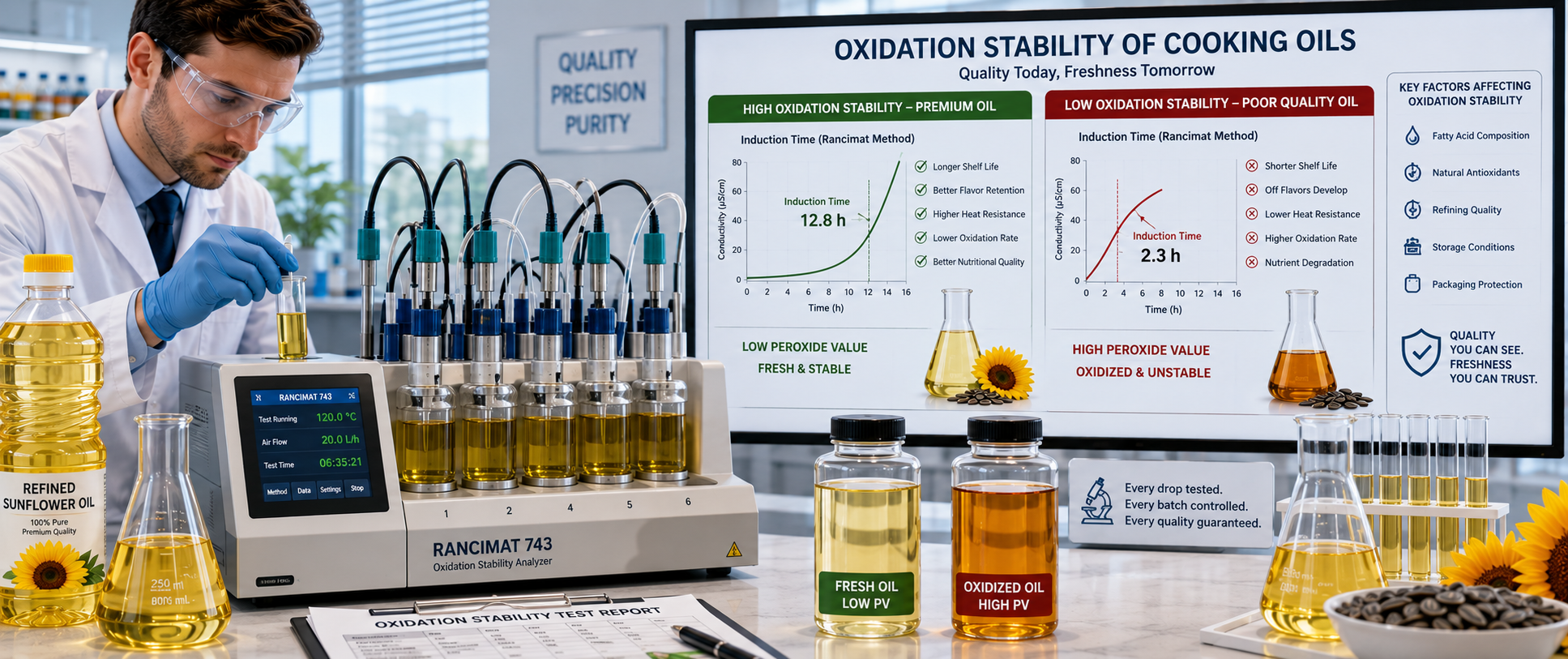
One of the most widely accepted methods is the Rancimat Test.
This accelerated oxidation test exposes oil to:
- Elevated temperature
- Continuous airflow
The instrument records the Induction Time, which represents how long the oil resists oxidation.
Longer induction times indicate higher oxidation stability.
What Is Induction Time?
Induction Time is the period before oxidation accelerates rapidly.
A longer induction time means:
- Better stability
- Longer shelf life
- Higher resistance to heat
Manufacturers often use induction time to compare different oil formulations.
Oxidation Stability of Different Oils
Approximate relative stability:
| Oil | Oxidation Stability |
|---|---|
| High Oleic Sunflower Oil | Excellent |
| Olive Oil | Very High |
| Avocado Oil | High |
| Refined Sunflower Oil | Moderate |
| Canola Oil | Moderate |
| Soybean Oil | Moderate |
| Corn Oil | Moderate |
| Flaxseed Oil | Low |
Actual performance depends on refining quality, antioxidant content, and storage conditions.
High Oleic Sunflower Oil
High Oleic sunflower oil contains significantly more monounsaturated fatty acids than conventional sunflower oil.
As a result, it offers:
- Higher oxidation stability
- Better frying performance
- Longer shelf life
- Improved thermal resistance
For industrial frying applications, High Oleic sunflower oil is often preferred.
Oxidation Stability During Frying
Repeated heating accelerates oxidation.
Stable oils:
- Produce less smoke
- Form fewer degradation products
- Maintain flavor longer
- Resist polymer formation
Poorly stabilized oils deteriorate much faster.
Export Quality and Oxidation Stability
International buyers frequently evaluate oxidation stability because exported oils may spend weeks in transportation and storage.
Premium export oils require:
- Low Peroxide Value
- Low Free Fatty Acids
- High oxidation stability
- Proper packaging
These characteristics ensure product quality upon arrival.
Relationship Between PV and Oxidation Stability
Although related, they are different measurements.
| Parameter | Measures |
|---|---|
| Peroxide Value | Current oxidation level |
| Oxidation Stability | Resistance to future oxidation |
Both are essential for evaluating edible oil quality.
How Manufacturers Improve Stability
Professional producers enhance oxidation stability through:
- Careful seed selection
- Gentle processing
- Advanced refining
- Nitrogen blanketing
- Oxygen-free storage tanks
- High-quality packaging
- Continuous laboratory monitoring
Every production stage influences final stability.
Common Misconceptions
“Dark-colored oil has better oxidation stability.”
False. Stability depends mainly on fatty acid composition and antioxidant protection.
“Refined oils are less stable.”
Not necessarily. Proper refining often improves oxidative stability by removing oxidation catalysts.
“Oxidation only occurs after opening.”
Incorrect. Oxidation begins whenever oil is exposed to oxygen, even inside sealed containers over long periods.
“All sunflower oils have the same stability.”
No. High Oleic sunflower oil is considerably more oxidation resistant than conventional sunflower oil.
Comparison Table
| High Oxidation Stability | Low Oxidation Stability |
|---|---|
| Longer shelf life | Shorter shelf life |
| Better frying performance | Faster deterioration |
| Lower oxidation rate | Higher oxidation rate |
| Better export quality | Reduced commercial value |
| Better flavor retention | Faster rancidity |
| Higher thermal resistance | Less heat resistant |
Frequently Asked Questions (FAQ)
What is oxidation stability?
It is an oil’s ability to resist oxidation during storage, transportation, and cooking.
Why is oxidation stability important?
Higher stability extends shelf life, preserves flavor, and improves cooking performance.
Which sunflower oil has the highest stability?
High Oleic sunflower oil generally offers significantly greater oxidation stability than conventional sunflower oil.
How is oxidation stability measured?
Specialized laboratory methods, such as the Rancimat test, determine the induction time before rapid oxidation begins.
Can consumers measure oxidation stability at home?
No. Accurate assessment requires laboratory equipment and standardized analytical procedures.
Related Articles
- Peroxide Value Explained
- Free Fatty Acids Explained
- Shelf Life of Edible Oils
- Storage Conditions for Cooking Oils
- How to Identify High-Quality Cooking Oil
- Best Temperature for Oil Storage
Conclusion
Oxidation stability is one of the most important indicators of edible oil performance and long-term quality. Oils with high oxidative stability retain their freshness, nutritional value, and cooking performance for longer periods, making them ideal for household use, food manufacturing, and international trade. By combining advanced refining technologies, proper packaging, and continuous laboratory testing, manufacturers can produce premium oils that meet the highest global quality standards.
Call to Action
Choose edible oils manufactured under internationally recognized quality management systems where oxidation stability, Peroxide Value, Free Fatty Acids, and other critical quality parameters are continuously monitored. Premium oils deliver lasting freshness, reliable performance, and confidence from production to every meal
Leave a Reply