



Sunflower oil and soybean oil are two of the world’s most widely produced and consumed vegetable oils. Both play an important role in household cooking, food manufacturing, and international food trade. Their versatility, affordability, and widespread availability make them common choices for frying, baking, and food processing.
Although these oils share several similarities, they differ in fatty acid composition, nutritional profile, oxidation stability, and ideal culinary applications.
Understanding these differences helps consumers select the most appropriate oil based on cooking style, nutritional preferences, and food preparation methods.
What Is Sunflower Oil?
Sunflower oil is extracted from the seeds of the sunflower plant (Helianthus annuus).
Commercial products include:
- Refined Sunflower Oil
- High Oleic Sunflower Oil
- Cold-Pressed Sunflower Oil
Refined sunflower oil is widely appreciated for:
- Neutral taste
- High smoke point
- Light color
- Excellent frying performance
High Oleic sunflower oil offers enhanced heat stability because of its higher monounsaturated fat content.
What Is Soybean Oil?
Soybean oil is extracted from soybeans (Glycine max).
It is one of the most extensively produced edible oils globally and is widely used in:
- Household cooking
- Food manufacturing
- Margarine production
- Salad dressings
- Processed foods
- Commercial frying
Most soybean oil available commercially is refined.
Nutritional Comparison
Both oils provide similar energy content.
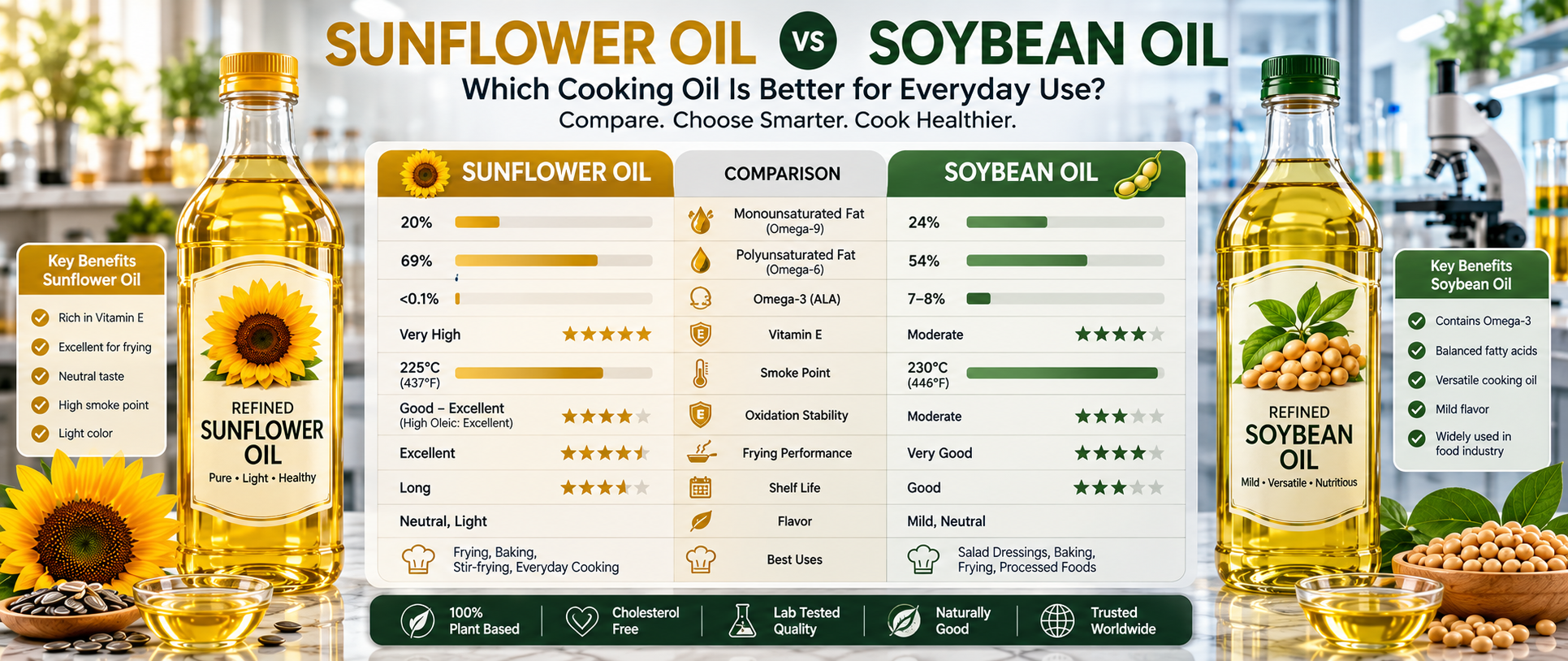
| Nutrient (Approximate) | Sunflower Oil | Soybean Oil |
|---|---|---|
| Calories | 884 kcal | 884 kcal |
| Total Fat | 100 g | 100 g |
| Saturated Fat | Low | Low |
| Monounsaturated Fat | Moderate (High Oleic: High) | Moderate |
| Polyunsaturated Fat | High | High |
| Vitamin E | Very High | Moderate |
| Cholesterol | 0 mg | 0 mg |
Both oils are naturally free of cholesterol.
Fatty Acid Composition
One of the most significant differences lies in their fatty acid profiles.
Conventional Sunflower Oil
Rich in:
- Linoleic Acid (Omega-6)
Contains moderate levels of Oleic Acid.
High Oleic Sunflower Oil
Contains substantially higher amounts of:
- Oleic Acid (Omega-9)
This improves oxidative stability.
Soybean Oil
Contains:
- Linoleic Acid (Omega-6)
- Oleic Acid (Omega-9)
- Alpha-Linolenic Acid (Omega-3)
Soybean oil naturally provides more Omega-3 fatty acids than conventional sunflower oil.
Vitamin E Content
Sunflower oil is among the richest natural sources of Vitamin E.
Vitamin E contributes to:
- Antioxidant protection
- Cellular health
- Oil stability
Soybean oil also contains Vitamin E but typically at lower concentrations.
Smoke Point
Approximate smoke points:
| Oil | Smoke Point |
|---|---|
| Refined Sunflower Oil | ~225°C |
| High Oleic Sunflower Oil | ~230°C |
| Refined Soybean Oil | ~230°C |
Both refined oils are suitable for high-temperature cooking.
Frying Performance
Refined sunflower oil is widely used for:
- Deep frying
- Fast-food preparation
- Snack production
- Commercial kitchens
High Oleic sunflower oil performs exceptionally well during repeated frying.
Soybean oil is also commonly used for:
- Restaurant frying
- Industrial food production
- Processed foods
- Frozen food manufacturing
Its mild flavor makes it suitable for many recipes.
Flavor Profile
Sunflower Oil
Characteristics:
- Neutral
- Clean
- Light
It allows the natural taste of food to remain unchanged.
Soybean Oil
Typically offers:
- Mild flavor
- Slightly bean-like notes (mostly removed during refining)
Properly refined soybean oil has a neutral taste suitable for everyday cooking.
Oxidation Stability
Oxidative stability depends largely on fatty acid composition.
General comparison:
- High Oleic Sunflower Oil → Excellent
- Refined Sunflower Oil → Moderate
- Refined Soybean Oil → Moderate
Both oils benefit significantly from proper refining and storage.
Health Considerations
Both oils contain predominantly unsaturated fats and can be included as part of a balanced diet.
Sunflower oil provides:
- High Vitamin E
- Unsaturated fatty acids
Soybean oil provides:
- Plant-based Omega-3 fatty acids
- Unsaturated fats
- Essential fatty acids
The overall quality of the entire diet is more important than reliance on any single cooking oil.
Food Industry Applications
Sunflower Oil
Common applications:
- Frying
- Bakery products
- Snack foods
- Sauces
- Household cooking
Soybean Oil
Widely used in:
- Margarine
- Mayonnaise
- Salad dressings
- Processed foods
- Commercial frying
- Food manufacturing
Both oils are essential ingredients in the global food industry.
Price Comparison
Soybean oil is generally among the most economical vegetable oils due to its large-scale global production.
Sunflower oil pricing varies depending on:
- Seed quality
- Production region
- High Oleic versus conventional varieties
- International market conditions
Prices fluctuate according to agricultural supply and demand.
Which Oil Should You Choose?
Choose Sunflower Oil if you prefer:
- High Vitamin E
- Excellent frying performance
- Neutral taste
- High smoke point
Choose High Oleic Sunflower Oil if you require:
- Superior oxidation stability
- Commercial frying performance
- Longer frying life
Choose Soybean Oil if you prefer:
- Plant-based Omega-3 fatty acids
- Versatile everyday cooking
- Broad industrial applications
- Cost-effective cooking oil
Many commercial kitchens use both oils depending on specific applications.
Comparison Table
| Feature | Sunflower Oil | Soybean Oil |
|---|---|---|
| Flavor | Neutral | Mild |
| Vitamin E | Excellent | Good |
| Omega-3 | Very Low | Present |
| Omega-6 | High | High |
| Smoke Point | High | High |
| Frying | Excellent | Very Good |
| Baking | Excellent | Good |
| Oxidation Stability | Moderate–Excellent | Moderate |
| Commercial Use | Extensive | Extensive |
Frequently Asked Questions (FAQ)
Which oil contains more Vitamin E?
Sunflower oil generally contains considerably more Vitamin E than soybean oil.
Does soybean oil contain Omega-3?
Yes. Soybean oil naturally contains alpha-linolenic acid (ALA), a plant-based Omega-3 fatty acid.
Which oil is better for frying?
Both refined oils perform well. High Oleic sunflower oil generally offers greater oxidation stability during prolonged frying.
Can sunflower oil and soybean oil be used daily?
Yes. Both oils can be incorporated into a balanced diet when consumed appropriately and according to individual dietary needs.
Which oil has a more neutral taste?
Both refined sunflower oil and refined soybean oil have mild, neutral flavors suitable for everyday cooking.
Related Articles
- Sunflower Oil vs Olive Oil
- Sunflower Oil vs Canola Oil
- Sunflower Oil vs Corn Oil
- High Oleic vs Linoleic Sunflower Oil
- Which Oil Is Best for Frying?
- Smoke Point of Sunflower Oil
Conclusion
Sunflower oil and soybean oil are both versatile vegetable oils widely used in homes and the food industry. Sunflower oil is recognized for its exceptionally high Vitamin E content, neutral flavor, and excellent frying performance, while soybean oil offers a balanced fatty acid profile that naturally includes plant-based Omega-3 fatty acids. Selecting the appropriate oil depends on cooking methods, nutritional priorities, flavor preferences, and intended applications. Understanding the strengths of each oil enables consumers to make informed choices for both everyday cooking and professional food preparation.
Call to Action
Explore our premium range of refined sunflower oils and High Oleic sunflower oils, produced under internationally recognized food safety and quality management systems. Whether for household kitchens, food manufacturing, or international distribution, our oils are designed to deliver outstanding performance, consistent quality, and trusted reliability in every bottle.
Leave a Reply