



When consumers purchase cooking oil, they often make quick judgments based on appearance alone. A bottle with a rich golden color may seem more natural, while a crystal-clear oil is often associated with purity. Some people even smell the oil before buying it, believing that a stronger aroma indicates better quality.
Although color, aroma, and clarity are indeed important quality indicators, they should never be evaluated in isolation. Each characteristic is influenced by the oil’s botanical origin, production method, refining process, storage conditions, and freshness.
Understanding these visual and sensory properties helps consumers distinguish between normal product characteristics and signs of deterioration, contamination, or poor processing.
Why These Characteristics Matter
The first quality assessment of edible oils is usually performed using sensory evaluation.
Professionals routinely examine:
- Color
- Clarity
- Aroma
- Texture
- Overall appearance
These observations provide valuable information before laboratory testing begins.
However, visual inspection alone cannot determine whether an oil meets international quality standards.
Understanding Oil Color
Oil color is one of the most misunderstood quality indicators.
Many consumers believe:
- Darker oils are healthier.
- Lighter oils are over-processed.
- Golden oils are fresher.
In reality, none of these assumptions is universally correct.
Oil color depends primarily on:
- Plant species
- Seed variety
- Harvest maturity
- Natural pigments
- Refining process
- Filtration
- Storage conditions
Natural Pigments in Edible Oils
Plants naturally contain pigments that dissolve into oil during extraction.
Common pigments include:
Carotenoids
Responsible for:
- Yellow
- Orange
- Golden colors
Found in:
- Sunflower oil
- Corn oil
- Palm oil
Chlorophyll
Produces:
- Green shades
Common in:
- Extra Virgin Olive Oil
- Avocado Oil
Xanthophylls
Contribute to:
- Yellow coloration
Especially present in many seed oils.
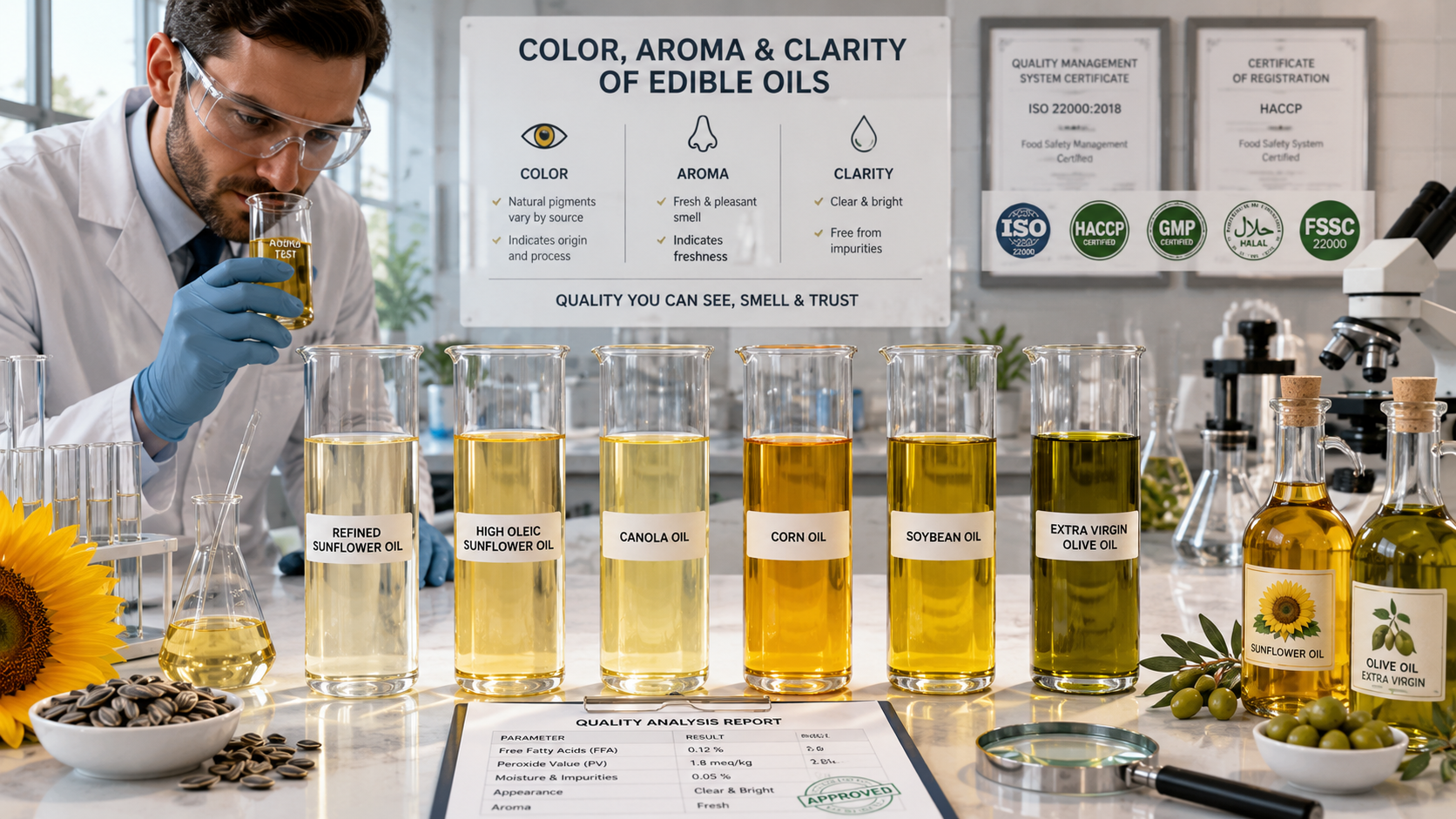
Typical Colors of Popular Cooking Oils
| Oil | Typical Color |
|---|---|
| Refined Sunflower Oil | Pale golden |
| High Oleic Sunflower Oil | Light golden |
| Corn Oil | Deep yellow |
| Soybean Oil | Light yellow |
| Canola Oil | Pale yellow |
| Olive Oil | Golden to green |
| Avocado Oil | Greenish yellow |
| Coconut Oil | Clear when liquid |
Each color is considered normal for its specific oil type.
Does Darker Mean Better?
Not necessarily.
A darker oil may simply contain more natural pigments.
Similarly, a lighter oil may indicate:
- Better refining
- Better filtration
- Different seed variety
Consumers should compare oils only within the same category.
What Is Oil Clarity?
Clarity refers to how transparent and free from suspended particles an oil appears.
Professionally refined oils should exhibit:
- High transparency
- No visible sediment
- No suspended particles
- Uniform appearance
Cloudiness does not automatically indicate poor quality.
When Is Cloudiness Normal?
Some oils naturally become cloudy under low temperatures.
Examples include:
- Olive oil
- Cold-pressed sunflower oil
- Avocado oil
This occurs because natural waxes crystallize.
Once the oil returns to room temperature, clarity usually improves.
When Cloudiness Indicates a Problem
Cloudiness may indicate poor quality when accompanied by:
- Water contamination
- Poor filtration
- Sediment
- Mold growth
- Oxidation
- Improper refining
Refined oils should remain consistently clear under normal storage conditions.
Understanding Oil Aroma
Fresh edible oils have characteristic aromas depending on their production method.
Refined Oils
Typically have:
- Mild smell
- Neutral aroma
- Very little flavor
Examples:
- Refined sunflower oil
- Refined canola oil
- Refined soybean oil
These oils are designed to perform consistently during cooking without affecting food flavor.
Cold-Pressed Oils
Cold-pressed oils retain much more of their natural aromatic compounds.
Typical aromas include:
- Nutty
- Fruity
- Seed-like
- Herbaceous
Examples:
- Extra Virgin Olive Oil
- Cold-Pressed Sesame Oil
- Cold-Pressed Sunflower Oil
Signs of Fresh Oil
Fresh oil generally smells:
- Clean
- Pleasant
- Mild
- Natural
The aroma should never be overwhelming or unpleasant.
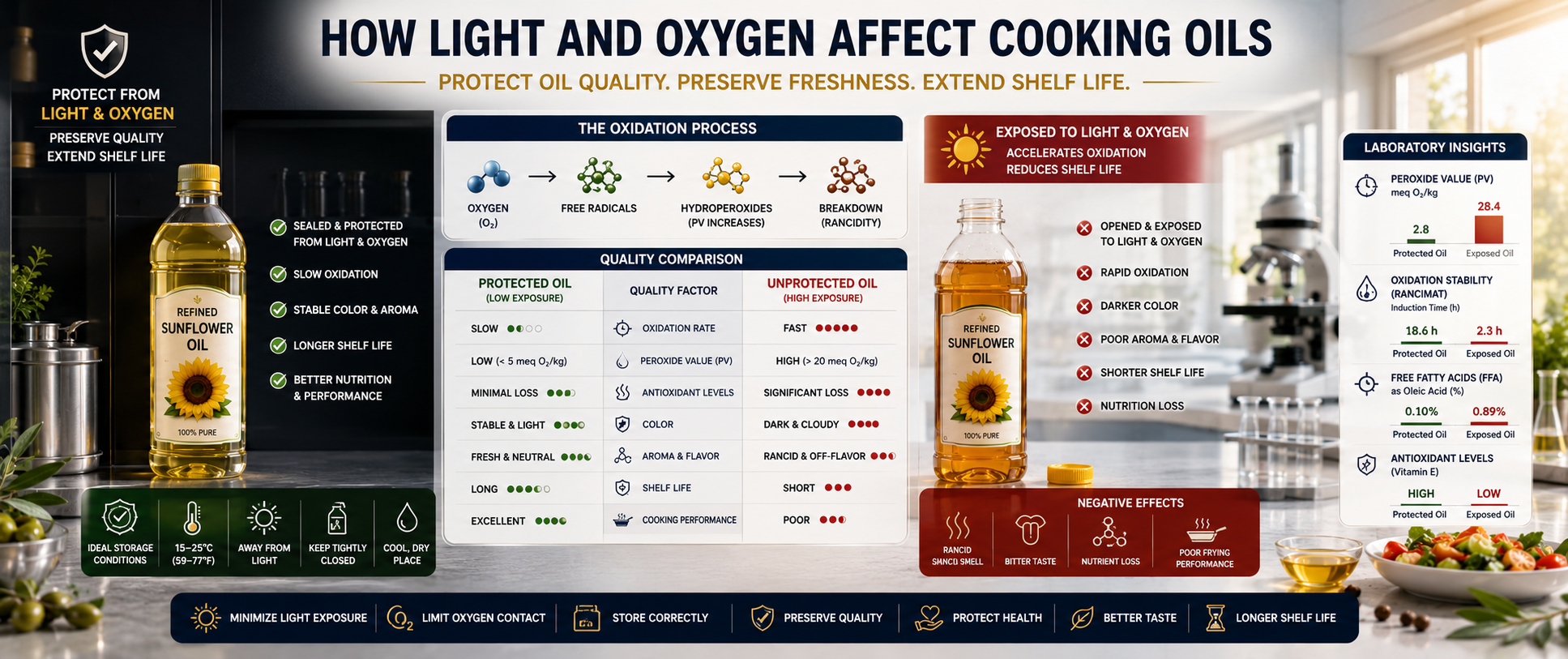
Signs of Oxidized Oil
As oil ages, oxidation produces undesirable compounds.
These compounds create odors described as:
- Paint-like
- Metallic
- Cardboard
- Stale nuts
- Rancid butter
- Sour
These are strong indicators that the oil has deteriorated.
How Oxidation Changes Appearance
Oxidation affects more than smell.
It may also cause:
- Darkening
- Loss of transparency
- Increased viscosity
- Sediment formation
Eventually, the oil becomes unsuitable for consumption.
The Role of Refining
Refining removes many naturally occurring substances, including:
- Waxes
- Phospholipids
- Pigments
- Odor compounds
- Trace metals
As a result, refined oils appear:
- Clearer
- Lighter
- More stable
- More neutral in aroma
This makes them ideal for high-temperature cooking.
The Influence of Storage
Storage conditions strongly affect color and aroma.
Poor storage can lead to:
- Pigment degradation
- Oxidation
- Loss of aroma
- Faster aging
Major factors include:
- Light exposure
- Oxygen
- Heat
- Moisture
Packaging Makes a Difference
High-quality manufacturers use packaging designed to preserve sensory quality.
Preferred packaging includes:
- Dark glass bottles
- UV-protected PET bottles
- Metal containers
- Airtight seals
These reduce oxidation and protect color.
Professional Sensory Evaluation
Food laboratories often perform sensory assessments before chemical analysis.
Experts evaluate:
- Color intensity
- Transparency
- Aroma strength
- Freshness
- Uniformity
- Presence of defects
Sensory testing is an essential part of quality control.
Laboratory Confirmation
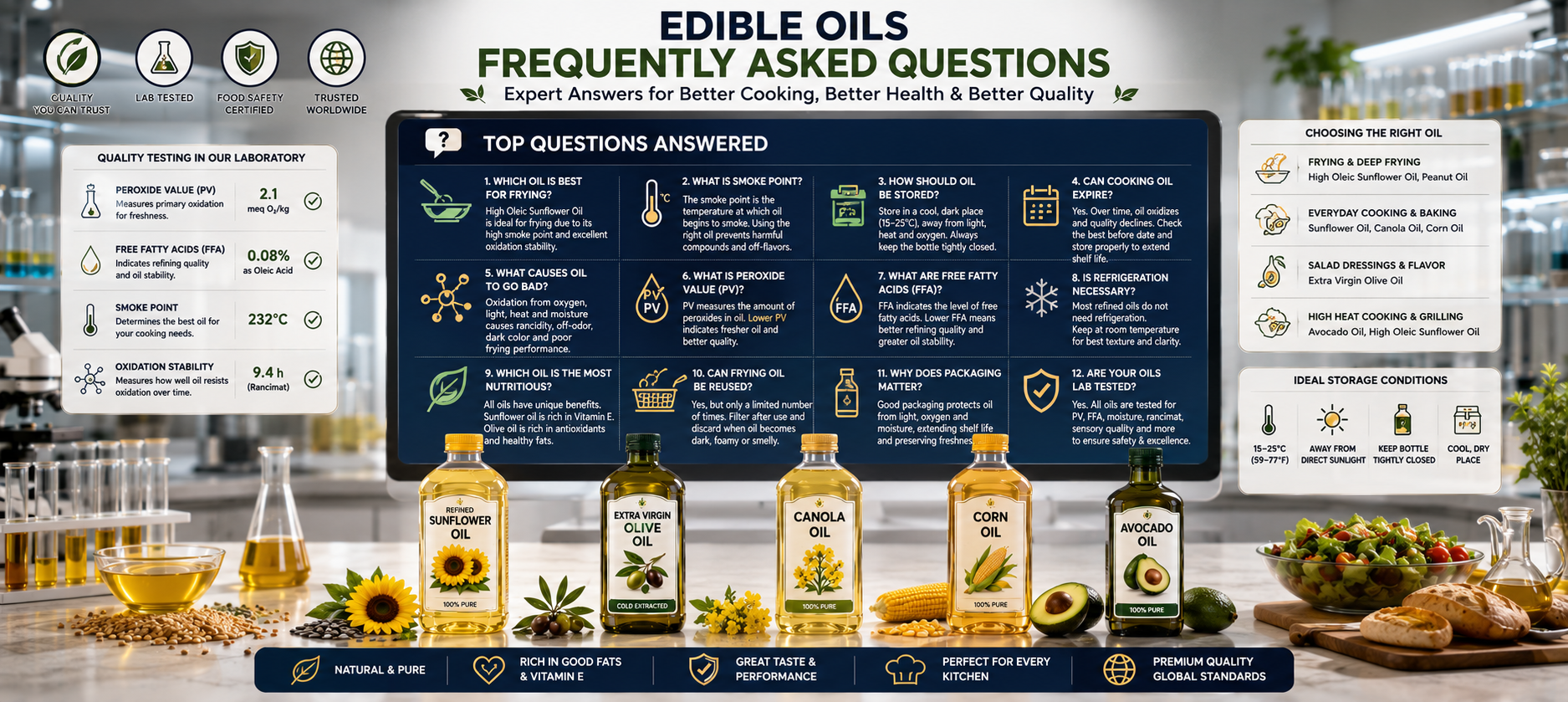
Although appearance provides useful clues, laboratory analysis confirms quality through measurements such as:
- Free Fatty Acid (FFA)
- Peroxide Value (PV)
- Moisture Content
- Insoluble Impurities
- Oxidative Stability
- Fatty Acid Composition
These objective tests verify whether the oil complies with food safety and quality standards.
Common Consumer Mistakes
Many buyers mistakenly believe:
- Darker oils are always healthier.
- Clear oils are always refined.
- Strong aroma means higher quality.
- Cloudy oils are spoiled.
- Green olive oil is always superior.
These assumptions are often inaccurate.
Quality should always be evaluated using multiple criteria.
Comparison Table
| Characteristic | Premium Oil | Poor-Quality Oil |
|---|---|---|
| Color | Uniform | Uneven or abnormally dark |
| Clarity | Clear and transparent | Cloudy or contains sediment |
| Aroma | Fresh and pleasant | Rancid or stale |
| Appearance | Bright | Dull |
| Sediment | None (refined oils) | Visible particles |
| Storage Condition | Properly protected | Signs of oxidation |
Frequently Asked Questions (FAQ)
Does darker oil mean better quality?
No. Color depends primarily on the type of oil and its natural pigments, not necessarily its quality.
Why is refined sunflower oil almost transparent?
The refining process removes pigments, waxes, and impurities, resulting in a lighter, clearer oil.
Should cooking oil have a strong smell?
Most refined cooking oils have a mild, neutral aroma. Strong unpleasant odors usually indicate oxidation or spoilage.
Is cloudy olive oil defective?
Not always. Olive oil may become cloudy when stored at low temperatures due to natural wax crystallization.
Can appearance alone determine oil quality?
No. Laboratory analyses and proper quality control are necessary to fully evaluate edible oil quality.
Related Articles
- How to Identify High-Quality Cooking Oil
- Free Fatty Acids Explained
- Peroxide Value Explained
- Oxidation Stability of Cooking Oils
- Shelf Life of Edible Oils
- Storage Conditions for Cooking Oils
- Reading an Oil Label Correctly
Conclusion
Color, aroma, and clarity are among the first indicators consumers notice when selecting edible oils, but they should always be interpreted within the context of the oil type, production method, and storage conditions. A premium oil exhibits consistent appearance, fresh aroma, and appropriate clarity while also meeting strict laboratory quality standards.
By understanding these sensory characteristics, consumers can make more informed decisions and better recognize products that reflect high manufacturing standards and optimal freshness.
Call to Action
Choose edible oils from manufacturers committed to international quality standards, advanced refining technologies, and rigorous quality control. Premium cooking oils deliver not only superior performance in the kitchen but also greater consistency, freshness, and confidence with every bottle.
Leave a Reply